From Heritage New Zealand, Spring 2009
by Ruth Le Pla
Returning ancestral bones to their original burial site is of cultural significance both to local iwi and to those engaged in doscovering our country's origins

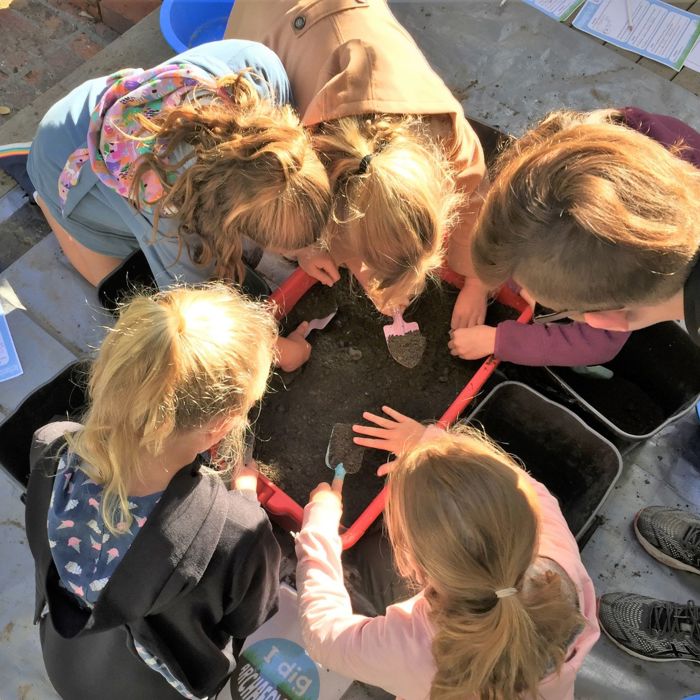
The wide, flat expanses of the Wairau bar are surveyed by archaeologists from the University of Otago
Quinn Berentson
16 April 2009. The Wairau Bar. Five simple coffins are lowered into the ground. It’s a bitterly cold day. Open grieving. Tears and silence. These people – for the remains of many are carefully placed in these few coffins – have been away from their resting place for nearly 70 years. Now they’re back. It’s a poignant end to a journey that arches back to our country’s first people and on, through them, to their forebears in East Polynesia.
The Wairau bar is an isolated sweep of land: long windswept boulder bank on the shores of Marlborough’s Cloudy Bay. It’s hard to access, wild and dangerous. Like many such places, it casts its own spell. The site is the Everest of New Zealand archaeology. It’s our iconic collective hearth, connecting us to our deep Pacific past.
University of Otago Associate Professor Richard Walter believes some of the first residents of the site – or at least their parents – may have been born in the homelands of the Cook Islands and Tahiti regions. “In scientific terms, the significance of the Wairau Bar site lies in what it tells us about the first communities who lived in New Zealand after arriving from tropical Polynesia in the founding canoes,” he says.
The site also anchors the identity of local iwi, Rangitane, whose chief executive, Richard Bradley, has led the third-generation push for these ancestral remains to come home to rest. Bradley is the greatgrandson of Peter Macdonald who was involved in the original Rangitane protests against the desecration of the burial sites; the protests commenced following the piece-by-piece removal of the remains which started with 13-year-old schoolboy Jim Eyles’ chance discovery of burial sites, moa eggs and Marquesanstyle necklaces in 1939.
Eyles went on to work the site with Canterbury Museum’s Roger Duff. The museum teams excavated from the 1940s through to the early 1960s, recovering large collections of stone and bone tools. They uncovered almost 50 human burials and elaborate grave goods including nearly 2000 ornate personal ornaments and whole moa egg shells. Midway through these excavations, Duff published The Moa-Hunter Period of Maori Culture, a seminal text in New Zealand science which set the foundation for the modern interpretation of our archaeology. Archaeologist Walter remembers delving into Duff’s book as a 12-year-old, drawn to the pictures and descriptions of the rich finds. The archaeology of those earlier excavations may have been basic by today’s standards but the work had at least established a baseline.
The moa hunters
When the first people landed on the shores, they found a rich source of birds, fish and sea mammals. Most importantly, the surrounding land provided moa – at least half a dozen different species. Their outsized bones remain in huge quantities. Walter says the Wairau Bar site laid to rest once and for all the notion that the moa hunters represented a pre-Maori group resident in New Zealand prior to the arrival of the founding canoes. “Instead, the Wairau Bar finds demonstrate clearly that moa hunting was simply an early phase of activity adopted by some Maori ancestors shortly after arrival in New Zealand,” he says. “When the site was first investigated it was clear to the archaeology teams that the style of the artefacts placed them in the earliest period of New Zealand settlement. Following the development of radiocarbon dating in the 1940s, this observation was confirmed. It is now understood that occupation commenced there between the last decades of the 13th and the first decades of the 14th centuries AD.”
This places the Wairau Bar within the first colonisation phase for New Zealand. It means the site is as old as, if not older than, any other site in the country. In Walter’s view, the artefacts recovered by the Canterbury Museum teams form the richest and most diverse assemblage from early New Zealand.
“They include a collection of stone adzes and specimens of such fine manufacture that they are considered to represent the pinnacle of Polynesian stone-working technology,” he says. “One of the key features of these stone tools is the striking similarity they bear to tools excavated from 14th-century sites in East Polynesia: the Cook Islands, Society Islands and the Marquesas.” Walter says this similarity in the stone artefacts, bone fish hooks, tattooing chisels and personal ornaments convinced archaeologists that Hawaiiki was located in East Polynesia.
Coming home
For all these years, most of the human remains have stayed put in the Canterbury Museum. Finally, after renewed negotiations involving Rangitane Runanga and Crown officials, the tupuna were returned to the Wairau Bar. Last year Rangitane brokered a deal with Te Puni Kokiri, Canterbury Museum, the University of Otago, the NZHPT and current Wairau Bar landowner, the Department of Conservation, which balances a bunch of cultural and scientific needs. It enabled Rangitane to return their tupuna to their ancestral burial grounds. It also allowed archaeologists to discover more about our country’s origins.
Walter points out that, unlike most other archaeological research programmes, the project was initiated by Rangitane. “Investigations at the Wairau Bar have a long history and one that has at times brought the scientific community into conflict with iwi,” he says. “An important goal of the current work has been to develop a sound partnership between iwi and the science community through which past difficulties can be reconciled and a constructive approach to protecting and understanding the various cultural and scientific values of this unique site can emerge.” Last year’s agreement allowed the archaeological team to design a research strategy that would provide a reburial site, as well as produce information on the nature of the early community.
Rick McGovern-Wilson, the NZHPT’s senior archaeologist, says one of the most significant aspects of this year’s work is that it’s finally “real archaeology”. “The primary focus of the Canterbury Museum’s excavations was on the burials and the artefacts,” he says. “They noted in passing that there were moa bones there. But archaeology has changed so much in the past 50 years. The ability to apply 21st-century techniques and ideas to such a significant site is really exciting.” There’s a richness now to the information that would never have been possible 50 years ago.
“It’s not just about digging stuff up,” says McGovern-Wilson. “It’s about the stories we can weave from microscopic information. DNA and isotope analysis, for example, tells us so much more than we were ever able to learn in the past.”
The work
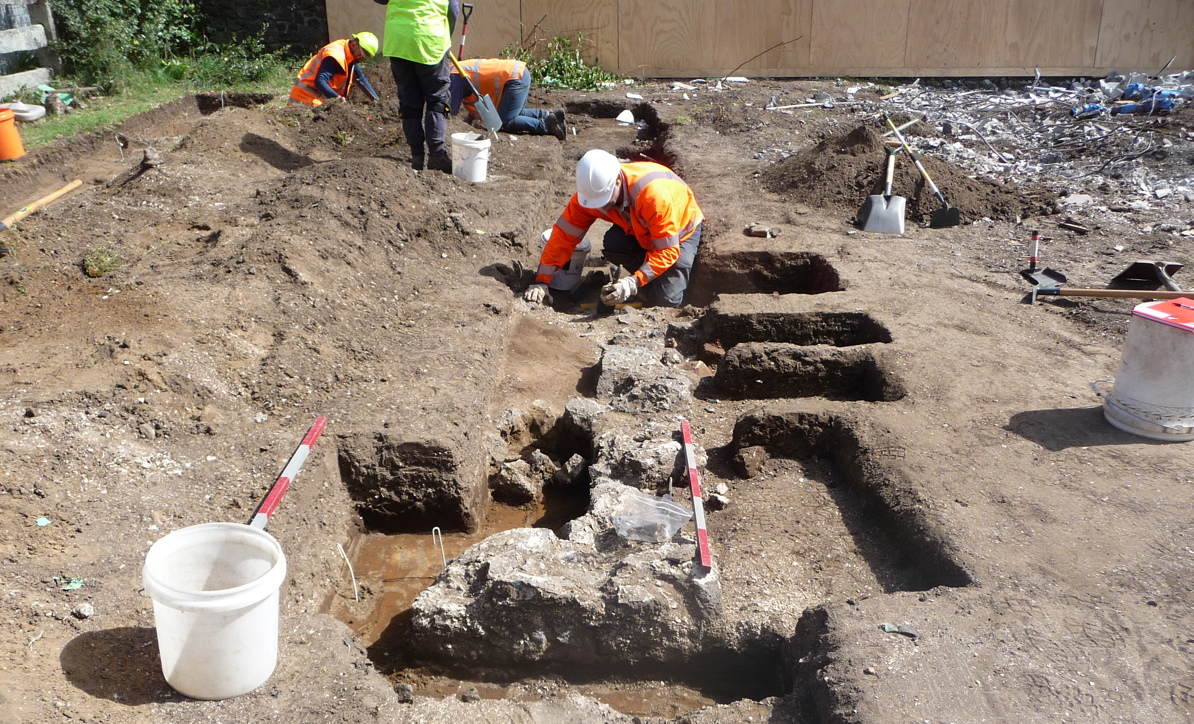
Before the excavations started, archaeologists swept the site with a magnetometer, remotely sensing the geophysics beneath and piecing together a map of the sub-surface features “This helped the team to locate their excavation units within the target zone,” says Walter, “as well as provide an estimate of the total area of the site left intact.” The original burials had come from three general locations. The goal was to concentrate excavation work in those areas. The tupuna would be reburied as close as possible to their original resting places. Walter says the magnetometer survey shows the site is much better preserved and much larger than previously anticipated. “Current estimates suggest that the site may be as large as 11 hectares,” he says, “although it’s likely this represents a series of different occupations spanning a few centuries.”
The team excavated last summer. One of the most impressive finds was a large, stone-lined hangi pit about five metres across and 1.5 metres deep. “The pit was lined with large river boulders suggesting that it was a permanent structure reused on numerous occasions. Its size suggests it was a communally used cooking facility,” says Walter.
Over time the pit was filled in with midden waste including the bones of both hunted and domestic meat sources such as moa and other birds, fish, dogs, sea mammals and shellfish. The excavators recovered some bone and stone fish-hooks from the site although Walter says the nature of the fishing adaptation is still unclear. “One of the great unknowns about the Wairau Bar was the question of site function,” he says. “Although earlier excavations focused on the burials, the latest show that burial was only one activity carried on in a large village complex.”
For Rangitane’s Richard Bradley, the recent excavations and the repatriation of his tupuna have rekindled a sense of connection with past peoples. Both events have reawakened an understanding that the Wairau Bar is a tangible place for Rangitane’s belief systems. “The physical act of reburying our tupuna allowed us to reconnect with the people who first buried them,” he says. “It has energised a lot of our younger people. I know it sounds abstract but you can’t have ancestral fires if the people who lit them have been taken away. Those bones were part of the land that we inherited from our previous generations.”
Like many Rangitane of his generation, the return of tupuna to the Wairau Bar and the restoration of the taonga have remained unfinished business for Bradley who sees himself as the latest in a line of Rangitane leaders agitating for the return of their Wairau Bar tupuna. Last year’s agreement allowed him to finalise the work of three generations. “Truthfully, I didn’t think it would be sorted in my lifetime. I thought it would roll on to another generation.”
Two drivers, he says, made repatriation possible now. Rangitane’s arguments for the return of their tupuna gained additional weight by being included in the iwi’s Waitangi Tribunal treaty settlement negotiations with the Crown and the iwi backed this up with a “shameless” media campaign highlighting its demands. “Without that,” says Bradley, “the repatriation probably wouldn’t have happened.” He has warmed to archaeology’s ability to reveal his iwi’s past. He believes his people are learning to take some of its positive aspects on board as they shed the negative image created by amateur archaeologists in the past.
“Archaeology isn’t one of those sciences that many Maori want to join. We grew up with an aversion to digging things up. My mum used to say, ‘If something’s sticking up out of the ground, you leave it alone. If it’s lying on top of the ground it’s been revealed to you and you’re allowed to take it’.” He says it didn’t help that the movie Indiana Jones and the Kingdom of the Crystal Skull was released last year, glorifying the role of soldier/adventurer/archaeologist.
Many iwi are wary. Bradley believes talking about projects such as the Wairau Bar can help alleviate their concerns. “We should be saying, ‘This is what iwi want to do. This is what the museum can do. This is what the university or archaeologists can do. And this is what we all get out of it’.” He wants his own people to learn more about the site and its significance. Already, he says, this year’s archaeological work is validating Maori oral traditions about the place: the Wairau Bar wasn’t just a Valley of the Kings burial site but also a place for the living.
Archaeological evidence echoes Rangitane memories: place-names recalling long-extinct pipi beds; stories of how tall their people were. There’s still much work to be done before many of these elements can be jigsawed together. It will be a year or more before the laboratory analysis is finished and the full results of the excavations known. The findings will culminate in a volume that describes the life of a small community living at the dawn of New Zealand history.
For now, Bradley draws comfort from what he has seen. “I was able to look down at the hearth of one of the whare,” he says. “I’ve had the opportunity to touch the ashes of those fires… to look at the cooking fire of my own old people.”