Skip to content.

Historic New Zealand - Pouhere Taonga

St Andrew's Church (Presbyterian)

print page

2 Symonds Street, AUCKLAND

Tell us what you think about the Register Online.

We're looking for ways to improve the Register Online and people's experiences when using it. Please help us by completing this brief survey.

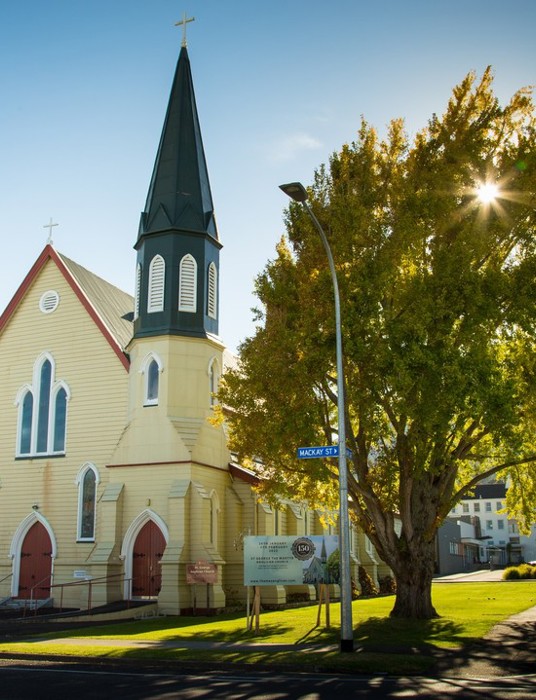
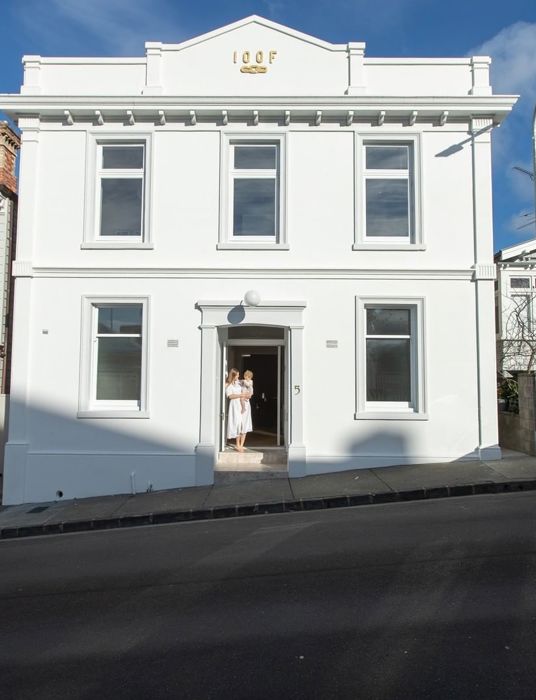
St Andrew's Church
St Andrew`s Church. Photographed by Martin Jones 18/09/2001. Copyright NZ Historic Places Trust

Enlarge image

St Andrew's Church
St Andrew`s Church. Photographed by Martin Jones 18/09/2001. Copyright NZ Historic Places Trust

Enlarge image

Registration Type
Historic Place Category 1
 
Register Number
20
 
Date Registered
23-Jun-1983
 
Legal Description
Lot 2 DP 120508
 
City/District Council
Auckland Council (Auckland City Council)
 
Region
Auckland Region
 
Summary
St Andrew's is the oldest survivng church in Auckland, having been erected in 1847-1850. It was built in a prestigious location, close to the colonial governor's residence in an elevated part of the early town. Associated from the outset with the principles of the Free Church of Scotland, the building was constructed to a simple rectangular design. It was built using local basalt and Mahurangi 'mudstone', overseen by the architect Walter Robertson. Its appearance contrasts with Anglican and Catholic churches of the day, and reflects the Scottish origins of its congregation. Early attendees formed an influential part of Auckland society, and sat in rows of pews that were rented out according to social rank. The governor of the colony, Sir George Grey (1812-1898), and the minister's family were allocated seats on either side of the pulpit, while soldiers from the local garrison occupied rows in the centre.

St Andrew's was transformed in the early 1880s, reflecting its role as the mother church of Presbyterianism in the region, as well as the prosperity of the local Presbyterian community. Major additions included a prominent front portico and offset tower, executed in a Greek Revival style, which vied with the nearby Supreme Court and Government House for architectural splendour. Internally an organ gallery was erected, contrasting with the practice of some other Presbyterian congregations, who preferred not to employ musical instruments. Stained glass windows and stencilled decoration were also introduced at around the turn of the century, though carefully excluding explicit Christian iconography. A steady decline in the residential nature of the parish nearly led to the closure of the church in the 1930s, and more recent alterations have been few. The parish having successfully revived, the building remains in regular use by the Presbyterian faith and is remarkable for having been used continuously for religious worship since its foundation.

St Andrew's Church is of national significance as the earliest remaining Presbyterian church in New Zealand, and as the oldest intact stone church of any denomination in the country. It is internationally important for its early links with the Free Church of Scotland, which had been founded in Scotland only shortly before, in 1843. The building has high spiritual value as a place of worship for more than 150 years, and as the mother church for Presbyterianism in northern New Zealand. It is valuable as one of Auckland's earliest surviving buildings, with connections to important personalities in the history of New Zealand and Auckland Province. The structure demonstrates the development of pioneer stonemasonry, as well as the Scottish roots of many early settlers in the region. It retains an unusually intact nineteenth-century interior, whose layout and appearance contribute to an understanding of religious and social history in both the early and later colonial periods. The oldest parts of the building form an important example of the architectural work of Walter Robertson, an early Auckland architect, while the tower and portico are among the most impressive commissions carried out by Matthew Henderson. The church has considerable aesthetic and landmark qualities, and is additionally valuable for its proximity to associated historic buildings, which include the former Government House, the Albert Barracks Wall and early colonial dwellings on Alten Road.
 
 
Current Use


Construction Professionals
  • Robertson, Walter - Architect
  • Henderson, Matthew - Architect
 
Notable Features
Registration covers the existing building, its fixtures and fittings. The building is on or close to the site of a Maori pa, Te Reuroa.
 
Construction Dates
  • Original Construction: 1847 (circa) - 1850 (circa)
  • Modification: 1880 (circa)
  • Addition: 1882 (circa) - 1883 (circa)
  • Modification: 1929 (circa)
  • Modification: 1968 (circa) - 1969 (circa)
  • Modification: 1986 (circa)
  • Modification: 1990 (circa) - 1991 (circa)
  • Modification: 2001 (circa)
 
Information Sources
  • Hilary Reid, 'St Andrew's Church, Symonds St, Auckland', Buildings Classification Committee Research Report, Wellington, 1976 (held by NZHPT, Auckland)
  • Salmond Architects, 'A Plan for the Conservation of the Presbyterian Church of St Andrew, Symonds Street, Auckland', Auckland, 1999 (held by NZHPT, Auckland)
 
 
Report Written By
Martin Jones
 
Report Completed
27-Sep-2001


Information on this page is correct to the best of the Trust's knowledge. If you have any additional information you would like to share with the Trust, please contact the Registrar. You may wish to contact the Trust to view our paper records.