Skip to content.

Historic New Zealand - Pouhere Taonga

St Matthew's Church (Anglican)

print page

28 Hope Street and Stafford Street, DUNEDIN

Tell us what you think about the Register Online.

We're looking for ways to improve the Register Online and people's experiences when using it. Please help us by completing this brief survey.

St Matthew's Church (Anglican)
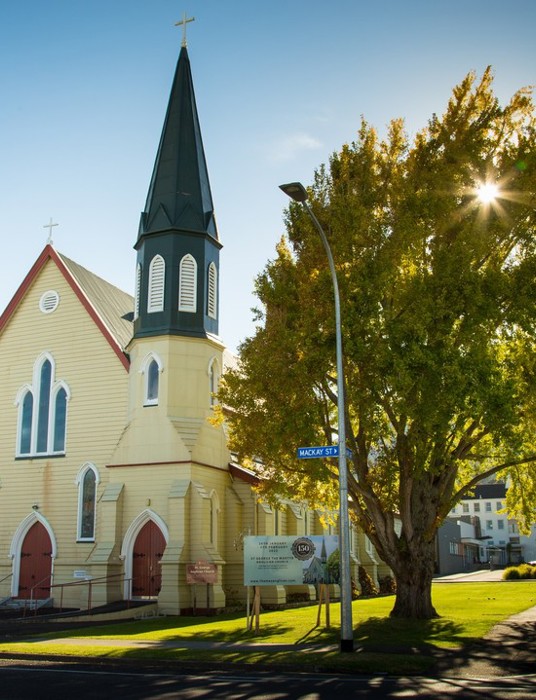
St Matthew`s Church (Anglican). Photographed by Stewart Robertson. Copyright Advertising & Art

Enlarge image

Registration Type
Historic Place Category 1
 
Register Number
2212
 
Date Registered
27-Jul-1988
 
Legal Description
Pt Sec 20 and Sec 21 Blk VI Town of Dunedin (CT 456195), Otago Land District
 
Extent of Registration
Extent includes the land described as Pt Sec 20 and Sec 21 Blk VI Town of Dunedin (CT 456195), Otago Land District, and the building known as the St Matthew's Church (Anglican) thereon, and its fittings and fixtures.
 
City/District Council
Dunedin City
 
Region
Otago Region
 
Historical Significance
By 1872 the population of the southern part of the city and towards Mornington had increased to a point where there were sufficient numbers to support a church to the south of St Pauls. Bishop Nevill convened a meeting on Christmas Eve 1872 at which it was decided to build a new church near the Market Reserve. Bishop Nevill chose a site higher up the hill on Stafford Street and the foundation stone was laid with full masonic honours 11 July 1873. The contractor, James Gore, built scaffolding to accommodate the spectators and a plan of the church was drawn in sand. The church debt was not paid off until 1901 and it was not consecrated until 1924. Around 1905 there was agitation to have the church declared the Cathedral since old St Pauls had lost its spire and looked insignificant by comparison. St Matthews was at the time the largest and noblest Anglican church in the city. The parish declined the suggestion and eventually the present St Pauls was built.
 
Physical Significance
Architectural Significance:

This is one of the most successful of Mason's ecclesiastical commissions, built just prior to retirement. It accords closely with accepted practice in England and the United States at the time, following reaction against French and Italian models. Mason subscribed to the journal 'Building News' where he would have seen drawings of English designs for such parish churches.

Townscape/Landmark Significance:

The church has become hemmed in by buildings such as the four storied Sew Hoy building next door, and so is less prominent that it was. It still remains an important building in the increasingly commercial area between Stafford and High Street.
 
Current Use
 
Former Use
 
 
Construction Professionals
 
Notable Features
Its well proportioned gables and spire and its unmodified nature.
 
Construction Dates
  • Original Construction: 1874 (circa)
 
Construction Details
The walls are dark Leith Valley andesite with the corner quoins and door and window frames in a light brown, rough finished Port Chalmers breccia. The roof is slate. There are label moulds of Oamaru stone over doors and windows. The church is cruciform in plan with a well proportioned spire and tower at the south-west corner of the nave over the main entrance porch. Internally the nave has octagonal columns rising to pointed arches, a timber roof with simply decorated braces, single lancet windows on the aisles and triple lancets, the middle one taller than its neighbours, lighting the end of each transept and the west end. The clerestory above the aisles is lit by quatrefoil windows in circular openings. The interior woodwork is Kauri and Rimu.
 
Information Sources
  • Frances Porter (ed), Historic Buildings of Dunedin, South Island, Methuen, Auckland, 1983.
 
Other Information
This historic place was registered under the Historic Places Act 1980. This report includes the text from the original Building Classification Committee report considered by the NZHPT Board at the time of registration.


Information on this page is correct to the best of the Trust's knowledge. If you have any additional information you would like to share with the Trust, please contact the Registrar. You may wish to contact the Trust to view our paper records.