Registration Type
Historic Place Category 1
Register Number
226
Date Registered
5-Apr-1984
Location Description
75 Hawker Street, Mount Victoria, Wellington
Legal Description
Lot 3 DP 76510 (CT WN42D/685), Wellington Land District
City/District Council
Wellington City
Region
Wellington Region
Summary
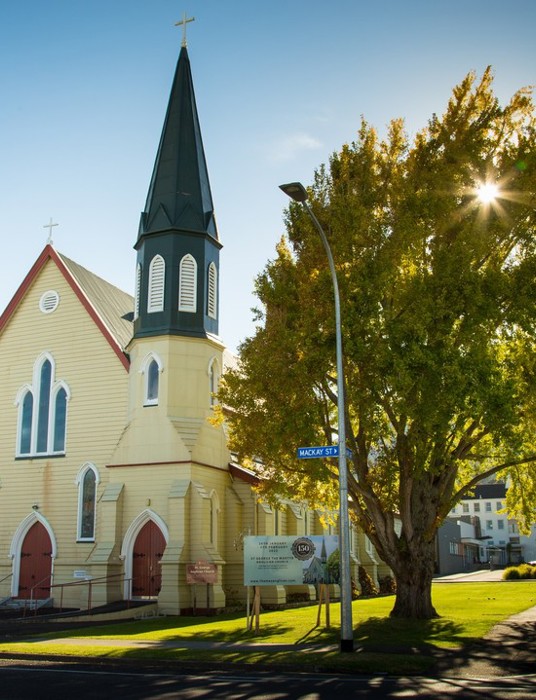
St Gerard's Church, the first church in the world to be dedicated to the Italian saint Gerard Majella, sits on an imposing site above Oriental Bay. It was erected in 1908 for the Redemptorists, an order dedicated to reviving the spiritual lives of Catholic parishioners. Prior to its construction, the Redemptorist fathers held mass in their own house, two rooms of which had been converted into a chapel. The new, purpose-built church represents the commitment of the Redemptorists to their work in New Zealand and, as it was funded entirely by public donations, shows the strong support that the fathers had inspired in the local community.
The church, incorporated into the new monastery in 1932, forms one of Wellington's most distinctive landmarks. The Catholic Archbishop Francis Redwood [1839-1935] foresaw the landmark potential of the site, and concerned that it would overshadow his Cathedral, initially objected to it. Reassured that the church would be a simple affair, the Archbishop relented and the well-known architect John Sydney Swan was asked to draw up some suitable plans.
Surviving the earthquake that occurred the day after it was opened, the Church was soon a centre of the Catholic community. Retreats or 'missions' and novena sessions attracted many Wellingtonians. The church, renowned for its choir, became known throughout New Zealand as its services were broadcast on national radio for 37 years. In 1965 the building became a parish church and, despite the departure of the Redemptorists in 1993, it continues in this role today. From its superb site overlooking Wellington Harbour, St Gerard's Church, remains a highly visible symbol of commitment and devotion.
The brick exterior of the church displays a large white cross over which a statue of Mary presides, heavy with child. The simple Gothic style of the church is reflected in the design of the monastery building built alongside the church in 1932. The eastern gable of the monastery mirrors the shape of the church, lending a pleasing air of symmetry to the combined composition. The interior of the church is simple, almost severe. The single storied structure forms a cross. Transepts branch off from main body of the church to the north and south. Framed with carved wood, the south transept contains the organ and the north transept acts as a vestry. Small alcoves behind each vestry house two minor chapels. The wooden pews, hand-carved by Brother Lawrence Watters, provide seating for 200 people.
The tall lancet windows are made of exquisite stained glass and provide relief from the stark, white plaster walls and timber floor and dado. The windows, depicting gospel scenes and saints, were made by Hardman and Son of Birmingham and are of very high quality. An oil painting of St Gerard in Ecstasy, gifted by the Vatican in recognition of the church's status as the first to be dedicated to the saint, once hung above the altar. It was returned to the Vatican in 1993 when the Redemptorists departed. From the altar to the organ, the many riches within the church were all public donations and illustrate the support commanded by the Redemptorists. Apart from changes to the exterior made when the church was incorporated into the monastery, the original form and fabric of the church has been retained. Changes to the interior have also been minor and reflect the building's role as a living centre of the Catholic community.
The spectacular location of the church and its combination with the large and impressive monastery has made the building one of Wellington's most significant and well-known landmarks. As the first church in the world to be dedicated to St Gerard Majella, the church has considerable international spiritual significance. As the first structure purpose-built for the Redemptorists in New Zealand the church can be considered a symbol of their commitment to their work in this country. The quality of the choir and the broadcast of weekly services on the national radio furthered public awareness of both the building and the Redemptorist mission. The high esteem in which the Redemptorists and church were held is demonstrated by the generous public support it received. The church has architectural significance as an example of the work of well-known local architect John Sydney Swan. Its juxtaposition with the monastery, the work of Swan's mentor Frederick de Jersey Clere, makes the building a unique piece of architectural history and adds greatly to the significance of the structure.
Construction Professionals
Notable Features
Cliff site created when much of the hill was removed during the Te Aro reclamation.
High quality stained glass windows.
Unusual statue depicting St Mary heavy with child.
Marble altar.
Pews.
Construction Dates
- Original Construction: 1908 (circa)
- Other: 1908 (circa)
- Other: 1910 (circa)
- Other: 1983 (circa)
- Other: 1985 (circa)
Other Information
A fully referenced version of this report is available from the NZHPT Central Region Office
Report Written By
Rebecca O'Brien
Report Completed
5-Oct-2002
Information on
this page is correct to the best of the Trust's knowledge. If you have any additional
information you would like to share with the Trust, please
contact the Registrar.
You may wish to contact the Trust to view our paper records.