Registration Type
Historic Place Category 1
Register Number
295
Date Registered
2-Apr-1985
Legal Description
Res 7 (CT CB373/217), Canterbury Land District
Extent of Registration
Extent includes part of the land described as Res 7 (CT CB47C/1021), Canterbury Land District and the structure known as St Michael and All Angels Church Belfry (Anglican), thereon.
City/District Council
Christchurch City
Region
Canterbury Region
Summary
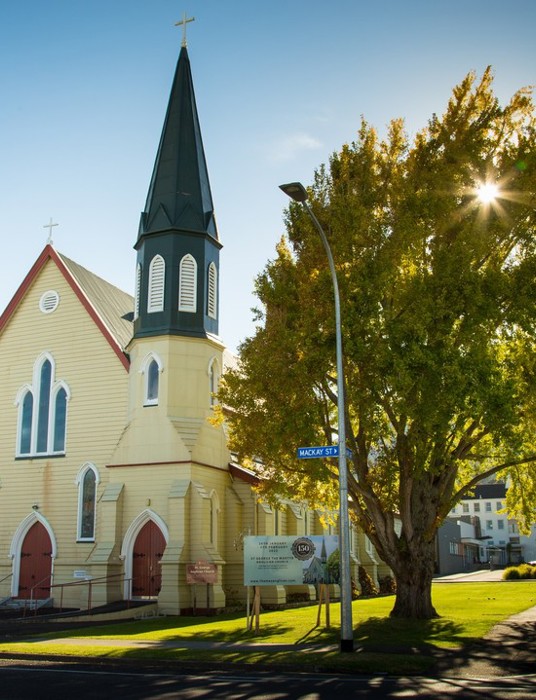
The free standing belfry at the church of St Michael and All Angels was designed in 1861 by Benjamin Mountfort (1825-1898), the pre-eminent architect in nineteenth-century Canterbury. St. Michael's was the first church to be constructed in Canterbury and was consecrated eight years later. Its bell had arrived from Britain with the Canterbury Association settlers in 1850 and was hung outside the first wooden church. The bell became damaged at some stage, although how and why seem to be lost in the realms of myth and legend. However the damage occurred, the bell was shipped back to England to be recast and Mountfort's belfry was designed to provide protection for the newly restored bell. It was also intended for use as a lychgate but was little used for this purpose. The cost of building the belfry was covered by public subscriptions.
Built in timber, the belfry became an instant landmark in the flat swampy landscape of nineteenth-century Christchurch. Dr. Ian Lochhead, in his recent book on Mountfort, traces the architectural sources back to medieval timber belfries, particularly those from Essex, and the timber belfries of Scandinavia. A model for the distinctive canopy of the belfry, Lochhead points out, was the roof of the eleventh-century tower of an Anglo-Saxon church, St. Mary's of Sompting, Sussex. The roof on the tower is said to be unique in England, although common in the Rhineland, and was pictured in John Henry Parker's Glossary of Terms used in Grecian, Roman, Italian, and Gothic Architecture, (3rd edition, 1840). A small number of English churches were built with such Rhenish helm roofs from 1850 onwards and Mountfort's belfry can be seen as part of the Victorian adoption of this roofing form. This reference to Anglo-Saxon buildings can be seen as a link between the origins of English ecclesiastical architecture and the position of the church in Canterbury in the 1850s.
The belfry at St. Michael and All Angels is significant as a prominent Christchurch landmark, and as an intriguing design, drawing on numerous historical sources, by the pre-eminent Victorian architect, Mountfort. It is associated with the arrival of the Canterbury Association settlers in Christchurch, and with the first church to be built in Christchurch (now replaced by the present S. Michael and All Angels).
Historical Significance
The Belfry has important historic values as it was built in 1861 alongside the first Church of St. Michael and All Angels, the first church to be built in Christchurch. At that time it provided a notable landmark within the flat environs of the evolving city and it remains a prominent streetscape feature. The bell the structure houses was brought to the province in 1850 with the first group of the Canterbury Association's settlers and represents the Association's plans for the province to develop as an Anglican community.
Physical Significance
Designed by Canterbury's Provincial architect B.W. Mountfort, the belfry illustrates his skills in the Gothic revival style and has considerable architectural value. Its elaborate form and detailing harmonises well with the present church, completed in 1872.
Summary of Assessed Criteria
The belfry can be assigned Category One status because it has outstanding historic associations with the first years of Canterbury's settlement and it represents the founding fathers' goals for the province to develop as an Anglican community. It is an important example of colonial design by a notable architect, it is part of a group of historic buildings and it is a landmark feature highly regarded by the people of Christchurch.
Construction Professionals
Construction Dates
- Original Construction: 1861 (circa)
- Relocation: 1976 (circa)
Construction Details
Timber, shingle roof
Other Information
A fully referenced version of this report is available from the NZHPT Southern Region Office.
Report Written By
Melanie Lovell-Smith
Report Completed
10-Dec-2001
Information on
this page is correct to the best of the Trust's knowledge. If you have any additional
information you would like to share with the Trust, please
contact the Registrar.
You may wish to contact the Trust to view our paper records.