Tell us what you think about the Register Online.
We're looking for ways to improve the Register Online and people's experiences when using it. Please help us by completing this brief survey.
Registration Type
Historic Place Category 1
Register Number
4909
Date Registered
18-May-1989
Legal Description
Lots 2 & 3 Pt Lot 1 DP 134277 Lot 2 Pt 1, NZ Gaz 1990 P2844
City/District Council
Auckland Council (Auckland City Council)
Region
Auckland Region
Historical Significance
This historic place was registered under the Historic Places Act 1980. This report includes the text from the original Building Classification Committee report considered by the NZHPT Board at the time of registration.
The number of crimes heard by Auckland Magistrates doubled between 1900 and 1910. In 1907 the Public Works Department acquired land for a Court to be constructed facing the Quadrant alongside an existing Court building. The earlier building was then used as Land and Deeds offices.
It is at this lowest level of the judiciary that people generally come into contact with the Courts. The District or Magistrates Court building was, for 75 years, the arena for this interchange and consequently played an important role in Auckland's social history.
The 1978 Royal Commission on the Courts recommended that the Magistrates Courts be renamed District Courts and be given a wider jurisdiction. This came into effect in 1980 and the term Magistrate is no longer in use.
The courtrooms of the Magistrates (later the District) Court have long been insufficient for the volume of cases heard in Auckland and in 1988 the District Court moved to new premises.
Physical Significance
This historic place was registered under the Historic Places Act 1980. This report includes the text from the original Building Classification Committee report considered by the NZHPT Board at the time of registration.
ARCHITECTURAL QUALITY:
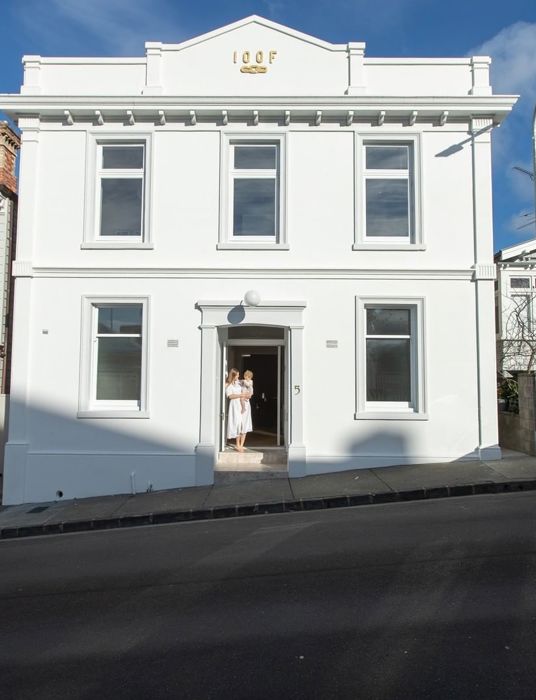
In the late nineteenth and early twentieth centuries (when British Imperial consciousness was at its zenith) architects in Britain sought to develop an architectural style expressive of Britain's position at the centre of a large Empire. By the turn of the century a free interpretation of the work of British architects of the late seventeenth and early eighteenth centuries (such as Sir Christopher Wren) was widely accepted, because of its exuberance and distinctively British character, as the architectural expression of British imperialism. Architects throughout the British Empire worked in the style. John Campbell was one of them and the Auckland District Court building designed under his aegis is a fine example of the style.
Like other Edwardian Baroque designers, Campbell and Paton combined Baroque elements in a very free manner. The elements which they used are ultimately inspired by seventeenth and eighteenth century Baroque architecture of England. The heavy striation of the ground floor of the facade of the District Court building is, for example, characteristic of Vanbrugh's Baroque buildings such as Blenheim Palace (cI705). Similarly, the colour of the Oamaru stone facing of the building invites comparison with that of the Portland stone favoured in England for the construction of Baroque buildings. Campbell and Paton use such elements, however, in an unrestrained and playful manner. The proportions of the building as defined on its main facade with a very high ground floor and short first floor does not adhere to the tenets of classical architectural proportion. Examples of such Baroque playfulness in the handling of classical architectural elements are becoming increasingly rare.
The building is representative of a very productive period in the history of the architectural division of the Public Works Department. It is one of many state buildings designed during a boom in public works initiated by the Liberal Government but brought to an end by the First World War. The District Court building (and the Auckland Post Office, 1908-12) are, however, distinctive. Their Oamaru stone facades contrast with the striped brickwork of Government buildings erected under Campbell's aegis in Wellington such as the Public Trust Office. J J and E J Clark's prizewinning design for the Auckland Town Hall may have set the precedent for the use of Oamaru stone in the construction of Baroque civic buildings in Auckland.
Architecturally significant features remain in the interior of the District Court building. Some of the original detailing is still intact.
The Australian Conservation Architect, Clive Lucas, has described the building as a 'Wonderful example of Edwardian architecture in the manner of Sir Edwin Lutyens who no doubt inspired the design.' He went on to say that work of this quality is rare in Australasia and he could not think of an example as fine. (Clive Lucas to Dinah Holman, 8 September 1988)
TOWNSCAPE/LANDMARK SIGNIFICANCE:
The Courthouse defines a visual boundary between Albert Park and the commercial Queen Street Valley. The scale of the buildings and the narrow streets and lanes enhance the predominantly pedestrian nature of the distinct enclave around High Street. Various views of the building are afforded by the curve of Kitchener Street. The building also faces open space and good medium and distance views can be seen from directly in front of the building.
The construction of the building on Kitchener Street conforms to Felton Mathew's original plan for the City of Auckland. In that plan all the major civic buildings were to be constructed along Victoria and Waterloo Quadrants. The siting and orientation of the Supreme (or High) Court and the District (or Magistrates) Court are mirror images about a central axis defined by Princes Street.
Construction Professionals
Construction Dates
- Designed: 1910 (circa)
- Other: 1911 (circa)
- Original Construction: 1912 (circa) - 1913 (circa)
Construction Details
The basecourse of the courthouse is constructed of Coromandel Tonalite and the three main facades are faced with Oamaru limestone. (See Hayward, 1987, p.44)
Other Information
A copy of this report is available from the NZHPT Northern Region office
Information on
this page is correct to the best of the Trust's knowledge. If you have any additional
information you would like to share with the Trust, please
contact the Registrar.
You may wish to contact the Trust to view our paper records.