Registration Type
Historic Place Category 2
Register Number
610
Date Registered
30-Apr-2010
Legal Description
Lot 2 DP 403436 (CT 411318), North Auckland Land District
Extent of Registration
Extent includes the land described as part of Lot 2 DP 403436 (CT 411318), North Auckland Land District and the building known as Freeman's Hotel (Former) thereon, and its fittings and fixtures. (Refer to map in Appendix 1 of the registration report for further information).
City/District Council
Auckland Council (Auckland City Council)
Region
Auckland Region
Summary
The former Freeman's Hotel is a late nineteenth-century urban corner pub designed by the noted Auckland architectural firm Edward Mahoney and Sons. Located in the traditionally working-class suburb of Freemans Bay, the ornate brick building was erected in 1886 on the site of an earlier hotel and has been in continuous use as a public house since that time.
Waiatarau (Freemans Bay) was traditionally used by Maori for settlement, fishing and trading. After the founding of colonial Auckland in 1840, the area became an important centre for industrial activity such as brickmaking, timber working and boatbuilding. Located on the waterfront, the first Freeman's Hotel was erected in circa 1859 by sawmiller and timber merchant James McLeod, broadly coinciding with of the construction of Drake Street as a main thoroughfare west from the city. In 1877, the Georgian-style timber building was purchased by Michael Dervan (1844-1898), during the period when land to the north of the hotel was being reclaimed. In 1885, Irish-born Dervan commissioned new premises.
The current Freeman's Hotel was erected towards the end of the hotel construction boom in central Auckland that followed more stringent requirements introduced under the Liquor Licensing Act 1881. The hotel's designers were Edward Mahoney and Sons, an architectural practice involved in the construction of many of Auckland's hotels, churches and business houses. In contrast to the earlier building, the new hotel was erected of brick and designed in an Italianate style, presenting ornately detailed facades to two streets. Internally, the ground floor is reported to have accommodated the public bar, a private-sitting room, a commercial room, a billiard room, the dining room and kitchen. Sitting-rooms, bedrooms and a bathroom were situated on the first and second floors.
In Auckland, as in other centres, much of everyday life centred on hotels where public dinners, meetings and inquests were held. Dervan's widow, Winifred, became the owner of the Freeman's Hotel in 1898 and continued to live on the premises with her family. The enterprise was leased to Great Northern Breweries which was keen to ensure security of beer supply in a competitive market. Shortly after the establishment and expansion of the nearby Municipal Destructor complex, a three-storey, three-bay extension designed by Mahoney and Sons was made to the hotel's Drake Street frontage (1908), doubling its size. The construction matched the 1886 design and was undertaken by Auckland contractors Fairweather and Brownlie. Its ground floor contained a dining room, kitchen, scullery and serving room whilst the upper floors provided further guest accommodation.
Notwithstanding the Freeman's Hotel's evident reputation as one of the suburb's most notorious pubs in the 1930s, a youth group later known as Boystown and subsequently Youthtown was founded in the basement during the Great Depression and operated there for some 14 years before relocating.
The Dervan family's eight-decade association with the hotel ended in 1965. In 1968 the Freeman's Hotel became a tavern. Subsequent changes included the introduction of a kitchen, lounge bar and dining area on the first floor, as hotels faced increasing competition from chartered clubs and restaurants. After a further change in ownership in 2000, some additions were removed and bedrooms on the second floor were replaced by four office tenancies. The former Freeman's Hotel now shares its surrounding site with a modern residential and commercial development. Two of the hotel's three floors remain in use as licensed premises.
The Freeman's Hotel (Former) has aesthetic significance for its visually ornate exterior. It has architectural value as an externally well-preserved late-Victorian urban, corner hotel designed in a decorative Italianate style. It is also significant as a notable surviving commercial example of the work of Edward Mahoney and Sons, a prolific and important Auckland-based architectural firm. The former Freeman's Hotel has historical value for reflecting the importance of hotels as places of relaxation and recreation in nineteenth- and early twentieth-century urban society; the impact of liquor licensing requirements; and the development of Freemans Bay as a notable industrial, working class suburb. The place has social significance for its longstanding connections with local residents, workers and sporting groups in what was historically one of Auckland's poorest communities.
Historical Significance
The former Freeman's Hotel is historically significant for demonstrating the importance of hotels and public houses as places of relaxation and recreation in nineteenth- and early twentieth-century urban society. The place reflects the impact of liquor licensing requirements, including the 1881 Licensing Act, after which the current building was erected. The place is significant for its close associations with a notable industrial, working class community in Freemans Bay, and has particular links with the development of a local industrial economy, the impacts of the Great Depression, and the suburb's gentrification and other transformation in the later twentieth century. The place also has close associations with significant New Zealand brewery companies, including Richard Seccombe's Great Northern Breweries, which reflect changing patterns of hotel ownership in the late nineteenth century.
It is notable as the birthplace (1932) and home for 14 years of the Boystown youth organisation, the forerunner of today's Youthtown, a significant organisation for Auckland's young people.
Physical Significance
Aesthetic Significance or Value:
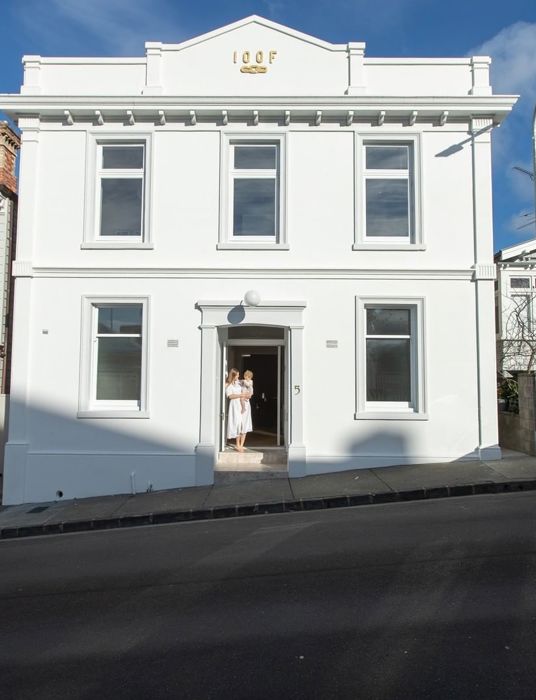
The former Freeman's Hotel has aesthetic value for its visually impressive and ornate exterior, which includes decorative plasterwork and a lavish parapet incorporating monumental pediments, balustrades and urns on pedestals. Four tall brick chimneys also contribute to the building's visual appeal. Its aesthetic significance is enhanced by being a local landmark, occupying a notable corner site close to a major thoroughfare providing access to and from Auckland's CBD. It retains some internal elements of aesthetic value, notably newel posts and large marble fireplaces on the ground and first floors.
Architectural Significance or Value:
The former Freeman's Hotel has architectural significance as an externally well-preserved late-Victorian urban, corner hotel designed in a decorative Italianate style. The building is of value as a notable surviving example of the hotel work carried out by Edward Mahoney and Sons, a prolific and significant architectural firm in late nineteenth- and early twentieth-century Auckland. Few of the twenty or so central Auckland hotels designed by Mahoney's practice during the late 1800s still remain.
Cultural Significance
Social Significance or Value:
The place has social significance as a venue of public interaction and gathering for one and a half centuries. The current building has been a place of social congregation within Freemans Bay for more than 125 years. The place has particular value for its associations with patrons and occupants of varying ages and backgrounds. These include sports groups, a youth group, local residents, and local and transient workers.
Summary of Assessed Criteria
(a) The extent to which the place reflects important or representative aspects of New Zealand history:
The former Freeman's Hotel reflects important and representative aspects of New Zealand history including attitudes towards alcohol consumption, working class recreation, and secular benevolence during the Great Depression of the 1930s, when the hotel's cellar became a place of care and leisure for under-privileged youth. The hotel also reflects urban intensification in late nineteenth- and early twentieth-century inner suburbs, and subsequent changes in inner-city living during the later twentieth century.
(g) The technical accomplishment or value, or design of the place:
The former Freemans' Hotel can be considered a notable example of late-Victorian corner pub design. It is significant as one of few inner-city hotels in Auckland to have retained its ornamental parapet, urns and pediments. Corner pubs were the predominant hotel design in urban areas during the late nine-teenth century, and attracted passing trade through their ornate style and other means. Both the 1880s structure and its 1908 addition demonstrate the archi-tectural accomplishments of the practice of Edward Mahoney and Sons, crea-tors of many of Auckland's notable commercial, residential and church build-ings.
(k) The extent to which the place forms part of a wider historical and cultural complex or historical and cultural landscape:
The place forms part of an important historical and cultural landscape in Freemans Bay, a notable nineteenth- and early twentieth-century working-class suburb. The hotel lies close to a number of significant structures linked with the suburb's industrial and residential past, including the former Auckland Municipal Destructor and Works Depot complex, the former Campbell Free Kindergarten and the Auckland Gas Company Administration Building. The current hotel marks the position of the colonial and earlier shoreline, which influenced the creation of the first public house on the site. The place lies within a Maori cultural landscape associated with Te To on the western headland, a fish-drying site at nearby Te Koranga, and a waka landing on the former foreshore used into the 1870s. It also lies immediately next to a group of three early twentieth-century lampstands on the corner of Vernon and Drake Streets, relocated to this site in circa 1968-1971.
Summary of Significance or Values
This place was assessed against, and found it to qualify under the following criteria: a, g, k.
Conclusion
It is considered that this place qualifies as a Category II historic place.
Construction Professionals
Historical Narrative
Early history of the site
The site of the current Freeman's Hotel (Former) is located in Waiatarau (Freemans Bay), a place traditionally used by Maori for settlement, fishing and trading. A pa at Te To on the western headland of the bay was occupied by Te Waiohua before the conquest of Tamaki-makau-rau by Ngati Whatua towards the mid eighteenth century. Te Paneiriiri on the eastern headland commemorates a later raid by Ngati Paoa. Following the formal creation of Auckland as colonial capital in September 1840, Freemans Bay developed as an early industrial working class suburb and supported enterprises including brick making, sawmilling and timber working. Maori continued to maintain a presence over the ensuing decades, drying fish on a structure known as Te Koranga at the foot of what is now Victoria Street West and hauling waka up on the foreshore. The proximity of the waka landing caused the local licensing authorities to refuse an application for a hotel in Drake Street East in 1865.
The land occupied by the future hotel occupied a waterfront site on a low bluff overlooking the bay. Initially part of a Crown Grant made to carpenter Hugh McLiver in 1845, the holding fronted what became Drake Street, the first and most important road in Freemans Bay and an eventual link between the city centre and the prestigious suburbs of St Mary's Bay and Herne Bay. Following subdivision of McLiver's grant in 1858, four land parcels were purchased by sawmiller and timber merchant James McLeod. In 1859 a publican's licence was sought for a hotel on the site known as the Freeman's Inn, and was granted to McLeod the following year.
Construction of the first Freeman's Hotel (circa 1859)
A building is likely to have been erected by the time of application and possibly as early as 1857, although a liquor licence was not obtained until 1860. The new hotel leased to publican Patrick Darby was well-located to serve coastal travellers, a growing residential settlement and workers in local industries.
The Freeman's Inn was a two storey timber building of Georgian design. It was one of over 70 licensed houses in Auckland in the 1860s, and one of five in Drake Street (which at that time extended east to Nelson Street). In 1868 the hotel, one of several serving a stretch of Auckland foreshore that became intensively industrialised, was purchased by the licensee and mortgagee Robert Stow. Stow sold to Michael Dervan in 1877. The hotel's proximity to the Freemans Bay waterfront was compromised by an Auckland Harbour Board reclamation constructed over the period 1875 to 1879. While use of the bay for shipping continued, new sites on the north side of Drake Street were taken up by residential and retail tenants as well as industries such as Cook's glassworks (circa 1882).
Construction of the current hotel (1886)
A new hotel building was commissioned by Michael Dervan (1844-1898) in 1885. Born in Loghrea, Ireland, Dervan - who was said to have been well connected - had emigrated to Melbourne in 1860. He had settled in Thames in 1868, prior to purchasing the Freeman's Hotel in 1877. In November 1885, architects Edward Mahoney and Sons called tenders for 'removing and rebuilding in brick the Freeman's Hotel', a contract won by the locally-based William Blewden (1826?-1888). References to the destruction of the circa 1859 structure by fire are unsubstantiated, as the hotel was still operating in its timber premises in January 1886. Auckland was reaching the end of a hotel construction boom which saw the rebuilding of older licensed establishments to meet the more stringent requirements of the Licensing Act 1881. Influenced by the temperance movement, the regulations placed an emphasis on hotels being places of public refreshment, with food and lodging always being available. Through the upgrading of such facilities, it was hoped that the worst excesses of alcohol consumption would be avoided. The Freeman's Hotel was completed by early June 1886.
Of impressive appearance compared with its timber predecessor, the three-storey brick building had a symmetrically-designed façade which extended three bays in each direction beyond its chamfered corner. The highly ornamented exterior was of the Italianate architectural style commonly used for corner hotels and commercial buildings during the late 1870s and the 1880s. Incorporating plaster dressings, it had pilasters that separated bays with segmental arch openings at ground floor level, more elaborately arched pediments on the first floor, and ornamented architraves on the second floor. The parapet was particularly lavish, and evidently included an inscription that proclaimed the name 'M. Dervan' and made claims to the solidity of the institution by referring to a foundation date in 1857.
The main entrance to the public bar was in the angled bay facing the intersection of Drake and Vernon Streets. Another entrance was centrally located on Vernon Street, while a third - on Drake Street - opened into the stair hall that served all floors. Internally, the ground floor is reported to have accommodated the public bar, the private sitting-room, the commercial room, the billiard room, dining rooms and a kitchen. The small size of the structure suggests that the new building was used in conjunction with an existing building to the west. On each of the first and second floors were sitting-rooms, bedrooms and a bathroom. The basement consisted of a brick-lined cellar.
The designers Edward Mahoney and Sons were a prolific and significant architectural firm in late nineteenth and early twentieth-century Auckland. The practice designed many banks and hotels during the 1870s and early 1880s, as well as numerous schools and churches, many of them Catholic. The Freeman's Hotel was one of some twenty Mahoney-designed corner hotels erected in Auckland in the late nineteenth century. Other surviving central city corner hotel buildings by the practice include the United Services (1874), the Metropolitan (1883), the Occidental, the Albion and the Aurora (all built in 1884), the Empire (1886), and the Shakespeare (1898). Owing to a greater capacity for passing trade, corner pubs became predominant in urban areas and more ornate in their design with bars that encouraged swift turnover through perpendicular (standing) drinking.
Later modifications and use
The Freeman's Hotel was erected just before the onset of a prolonged economic depression that is likely to have particularly affected the working-class community of Freemans Bay. In Auckland, as in other centres, much of everyday life centred upon hotels where public dinners, meetings and inquests were held. During the 1880s, there were said to have been few other places of entertainment in the city. Recreational drinking was an important aspect of colonial working-class culture, particularly for men, and may have been especially prevalent in poorer urban districts such as Freemans Bay. Prohibitionists campaigning for the abolition of alcohol considered its consumption to be a major cause of poverty, although others looked to broader social and economic reasons.
Following Michael Dervan's death in 1898 his widow Winifred became the owner of the Freeman's Hotel which she leased to the Great Northern Breweries. The involvement of the firm founded by Richard Seccombe, said to be New Zealand's earliest commercial brewer, reflected a growing trend of large brewery companies taking over individual hotels. In part such moves were a response to the increasing pressures of the temperance movement and a decreasing number of liquor licences.
Following the revival of Auckland's economic fortunes the Freeman's Hotel was extended in 1908, the year a national vote did not quite reach the required two-thirds majority for prohibition. Patrons of the enlarged hotel are likely to have included workers from the adjoining Auckland City Municipal Destructor complex which opened in 1905. The three-storey extension was designed by the firm Mahoney and Sons, architects of the 1886 building, and added a further three bays facing Drake Street. The addition, an exact match of the earlier section, was constructed by Fairweather and Brownlie about whom little is known.
The building's existing western entrance lobby, hall and staircase served the enlarged Freeman's Hotel. The ground floor of the addition contained a dining room, kitchen, scullery and serving room. On the first floor were a further six bedrooms; and on the second, four bedrooms and a bathroom. The Dervan family lived in part of the hotel, leaving 18 guest rooms available.
From circa 1923 until circa 1937 the hotel was run by Dervan's sons Eugene and William and from circa 1946 until 1958 by a grandson. By 1928, an extension had been built on the southeast side, to accommodate an extended public bar and a small private bar (since demolished). Fire damaged the corner rooms of the hotel's second storey in November 1935. Under Dominion Breweries' management in 1936, architect Norman Wade (1879?-1954) designed alterations to provide a small separate Women's Bar within the main bar area, perhaps reflecting an increasing patronage by women. Further plans a year later doubled the size of the private bar. The doorway to Vernon Street was converted into a window.
Notwithstanding the Freeman's Hotel's reputation as one of the suburb's most notorious pubs in the 1930s, it also provided some social and community benefit. Due in part to proximity to Victoria Park (1905) and other sporting venues, local hotels served as clubrooms, places for after-match socialising and were of major importance to many local recreational groups. In 1932 during the Great Depression, a youth group was started by Bill Dervan in the Freeman's Hotel basement. Initially a boxing club, haven and soup kitchen, the group for underprivileged boys operated there for 14 years and became Boystown, the forerunner of today's Youthtown, a significant organisation for the city's young people.
The Dervan family's eight-decade association with the Freeman's Hotel ended in 1965 upon sale of the property to Leopard Breweries. In 1967, five decades of 'six o'clock swill' ended in New Zealand with the introduction of ten o'clock hotel closing. By this time Freemans Bay's close-knit community of working-class residents had been replaced by a highly mobile tenant population following an earlier declaration of a substantial part of Freemans Bay as a slum clearance area.
The Freeman's Hotel became a tavern in 1968. The long public bar counter was removed and the ground floor layout was reconfigured. A smaller counter now served two private bars in the former kitchen and dining room area as well as the large public bar. The fit-out included paneling and cabinetry based on a Victorian bar theme. Men's toilets on the ground floor were reconfigured and a stairway and new toilets were added at first floor level. In 1970, as hotels faced increasing competition from chartered clubs and restaurants, first floor bedroom accommodation and a manager's suite were converted into a kitchen, lounge bar and dining area. Removal of the slum clearance designation in 1973 brought gentrification to Freemans Bay. Between 1968 and 1971, three early twentieth-century electric street lamps were relocated from elsewhere in the city to the public footpath adjoining the hotel property.
In 2002, Leopard Breweries sold the establishment which was by then known as Kitty O'Brien's Irish Pub. The ground and first floors were fitted out as entertainment facilities and the hotel was renamed The Drake. Subsequently, cellar access was relocated from the front bar to a new doorway off the front lobby. The building's twentieth-century annexes and additions were demolished leaving the 1886 and 1908 sections of the hotel. The section of stairway between the ground floor and first landing was reinstated. In 2005, surviving bedrooms on the second floor were converted into four office tenancies. The rest of the building remains in use as a public house.
A commercial and residential development has been recently constructed on adjoining land to the south, within part of the legal title not occupied by the hotel building.
Construction Dates
- Addition: 1908 (circa) - 1909 (circa)
- Addition: 1926
- Modification: 1936 (circa)
- Modification: 1937 (circa)
- Demolished - Other: 1968 (circa) - 1970 (circa)
- Modification: 2002 (circa) - 2003 (circa)
- Modification: 2009 (circa)
- Original Construction: 1886 (circa)
Construction Details
Brick walls, plaster dressings, corrugated metal roof
Other Information
A fully referenced version of this report is available from the NZHPT Northern Region Office.
Report Written By
Martin Jones, Lucy Mackintosh and Joan McKenzie
Report Completed
25-Mar-2010
Information on
this page is correct to the best of the Trust's knowledge. If you have any additional
information you would like to share with the Trust, please
contact the Registrar.
You may wish to contact the Trust to view our paper records.