Skip to content.

Historic New Zealand - Pouhere Taonga

Myers Park Historic Area

print page

Upper Queen St, AUCKLAND

Tell us what you think about the Register Online.

We're looking for ways to improve the Register Online and people's experiences when using it. Please help us by completing this brief survey.

Myers Park Historic Area
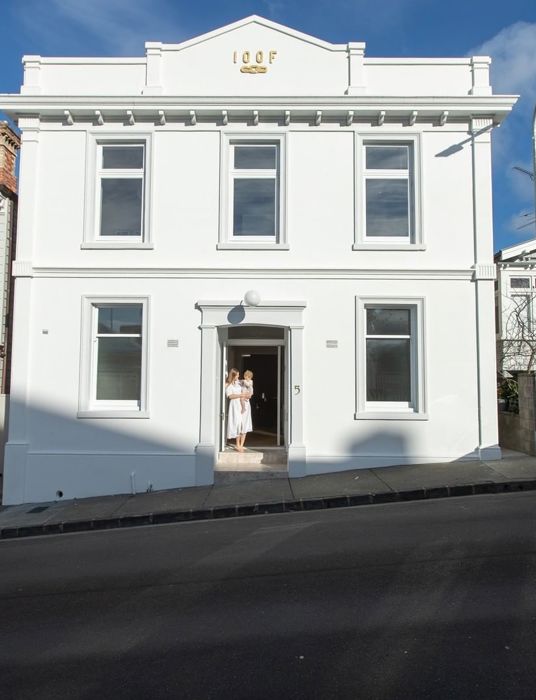
Myers Park Historic Area. Photographed by Martin Jones 4/09/2009. Copyright NZ Historic Places Trust

Enlarge image

Plan of Historic Area from registration report.
Plan of Historic Area from registration report.. Copyright NZ Historic Places Trust

Enlarge image

Registration Type
Historic Area
 
Register Number
7008
 
Date Registered
16-Dec-1994
 
Extent of Registration
Parts of Myers Park in Upper Queen St, including the Myers kindergarten; terrace of shops in Upper Queen St; Theosophical hall; entrance and seats in Myers Park; and several stands of trees.
 
City/District Council
Auckland Council (Auckland City Council)
 
Region
Auckland Region
 
Summary
GENERAL DESCRIPTION:

The buildings within the area were built over a fourteen year period from 1908 until 1923 and illustrate the transformation of what was substantially a residential area on the periphery of Auckland's commercial centre to an area of commercial/community character.

Although introduction of electric trams to Auckland in 1902 enabled services to be provided on routes previously too steep for horse-drawn trams, it was not until October 1916 and the establishment of a line via the Town Hall to Karangahape Road that the area became more accessible. The locality was also seen as more desirable following the development of Myers Park, a former slum area in the gully between Queen Street and Greys Avenue. The money necessary to transform the area had been donated by the previous Mayor of Auckland, Sir Arthur Myers. As Mayor, Myers had taken the initiative in 1911 proposing legislation to introduce town planning to New Zealand; however, it was not until 1926 that New Zealand's first Town Planning Act was passed.

At the park's opening ceremony in February 1915, Sir Arthur Myers announced his intentions to donate the necessary money to build a kindergarten. This was opened eight months later.

In 1917 the YWCA Building was completed. A few years later the Myers Park area had been considered unsuitable by the Board but by 1917 the trams were running up Queen Street and the building could serve the young women employed in both the Queen Street and Karangahape Road business areas. The YWCA and the Kindergarten both served as community facilities, for example, during the 1918 influenza epidemic they served as temporary hospitals. The YWCA Building was demolished in 1985 and replaced by the IBM Centre (a nine storeyed concrete office block with blue mirror glass cladding) which is not included in the area.

Other buildings of significance in the area are a block of sixteen terrace shops along Queen St with dwellings above (1908) and the more recent Theosophical Society Hall erected in 1922. (The Theosophical Society was founded in Auckland in 1891)

The clearance of the slum area to create this park environment illustrates the growing awareness at that time of the importance of fresh air and sun in urban centres and the need for more controlled town planning. The park, enhanced by a range of architectural styles, has significant townscape value.
 
Historical Significance
This area is particularly significant in terms of the redevelopment of a once slum area into a commercial/community centre. The creation of Myers Park together with community facilities such as the Kindergarten indicate Auckland's growing interest in the importance of town planning in the early decades of the twentieth Century. The redevelopment of this area was made possible with the improvements in transportation.
 
Physical Significance
Architectural:

The buildings grouped around the formal entrance to Myers Park represent the diversity of architectural styles common during the first quarter of the century. The terrace shops with a range of features incorporated into their design illustrate the eclectic nature of Edwardian architecture. The Kindergarten is designed in the Arts & Crafts style, popular at the time, and in contrast, the Theosophical Society Hall follows a more traditional neo-Classical design.

Aesthetic:

The Myers Park area has aesthetic appeal and acts as a mediating space between the parkland and the urban nature of Queen Street. The area is enhanced by mature trees and a group of historic buildings ranging in architectural styles.
 
Cultural Significance
Cultural/Social:

This area underwent considerable change around the turn of the century. A slum housing area was transformed into an attractive recreational space with community facilities reflecting the community's expectations of better urban conditions.


Other Information
This historic place was registered under the Historic Places Act 1993. This report includes text from the original Proposal for Registration considered by the NZHPT Board at the time of registration.


Information on this page is correct to the best of the Trust's knowledge. If you have any additional information you would like to share with the Trust, please contact the Registrar. You may wish to contact the Trust to view our paper records.