Skip to content.

Historic New Zealand - Pouhere Taonga

Levy Buildings

print page

20 Customs Street East, Commerce Street and Galway Street, AUCKLAND

Tell us what you think about the Register Online.

We're looking for ways to improve the Register Online and people's experiences when using it. Please help us by completing this brief survey.

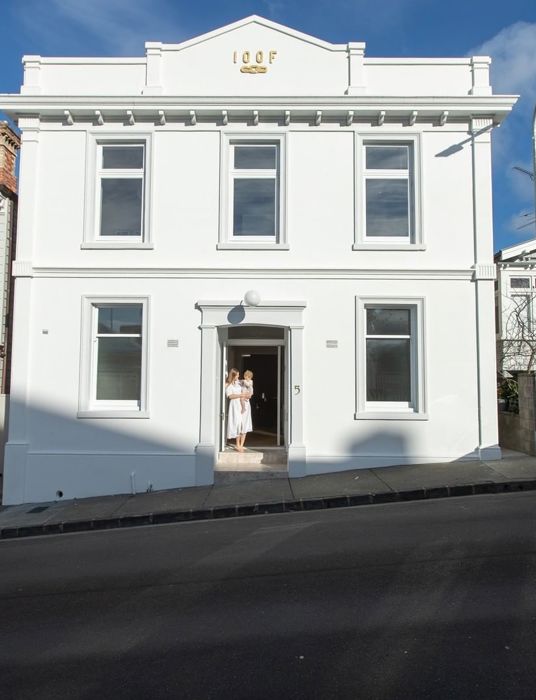
Levy Buildings
Levy Buildings. Copyright Britomart Group

Enlarge image

Levy Buildings
Levy Buildings. Photographed by Marin Jones 9/05/2011. Copyright NZ Historic Places Trust

Enlarge image

Registration Type
Historic Place Category 2
 
Register Number
7292
 
Date Registered
14-Dec-1995
 
Legal Description
Lot 2 DP 361575 (CT 280326), North Auckland Land District
 
Extent of Registration
Extent includes the land described as Lot 2 DP 361575 (CT 280326), North Auckland Land District, and the building known as Levy Buildings thereon, and its fittings and fixtures.
 
City/District Council
Auckland Council (Auckland City Council)
 
Region
Auckland Region
 
Historical Significance
This historic place was registered under the Historic Places Act 1993. The following text is from the original Recommendation for Registration considered by the NZHPT Board at the time of registration.

The Levy Building was built circa 1896 for tea merchants and indent agents Gilmore, Younghusband & Co. During World War II the premises housed the YWCA's Downtown Club, an organisation that catered for the social needs of women in the armed services.

The establishment of the Downtown Club was an effort to provide for the social needs of women in a period when their role and place in society underwent considerale and rapid change brough about by the demands resulting from World War II.
 
Physical Significance
This historic place was registered under the Historic Places Act 1993. The following text is from the original Recommendation for Registration considered by the NZHPT Board at the time of registration.

Architectural:

Although originally built in 1896, Levy Buildings is now predominantly Art Deco in style after the remodelling of the exterior in the 1930s. Some elements of the original Classical facade are still evident however.

The interior of this buildings seems to have undergone the usual development where the original walls, ceilings and floors remain unchanged but act as hosts to partition walls. The stairwell, stairs and balusters appear to be unchanged (except for the carpets) and the Art Deco modelling of the windows in the 1930s has not been changed on the inside.

Archaeological:

Parts of this area have archaeological potential.
 
Cultural Significance
This historic place was registered under the Historic Places Act 1993. The following text is from the original Recommendation for Registration considered by the NZHPT Board at the time of registration.

Social:

The use of the building by the YWCA as a social club for service women during World War II adds to its social significance. The establishment of the club was an effort to provide for the social needs of women in a period when their role and place in society underwent considerable and rapid change.
 
Summary of Assessed Criteria
This historic place was registered under the Historic Places Act 1993. The following text is from the original Recommendation for Registration considered by the NZHPT Board at the time of registration.

The following comments are made in relation to the criteria identified under S.23(2) of the Historic Places Act 1993.

a) The extent to which the place reflects important and representative aspects of New Zealand history.

b) The association of the place with events, persons or ideas of importance in New Zealand history:

The Levy Building reflects the importance of merchandising warehouses to New Zealand cities. In a colony which lacked substantial manufacturing industries, importing was an important business activity. These merchandising warehouses were usually clustered around the interface between the waterfront and the central business district. Its use, at vice-regal request, as a social centre for service women during the Second World War adds to its social history significance.

c) the potential of the place to provide latowledge of New Zealand history.

The Customs St East buildings all stand on land reclaimed between 1879 and 1886 and therefore have archaeological significance.

Reclamation of the seabed commenced in 1859. The outer edge of the northern side of Customs St was initially bounded by a muddy embankment and on the seaward side of the reclamation were massive stone retaining walls. Customs St provided access to a number of wharves constructed out across the mudflats of Commercial Bay to deeper water. Between 1879 and 1886 the reclamation continued in a northerly and easterly direction forming the land between Customs and Quay St. This is the land on which the warehouses now stand.

It is probable that a large quantity of material will have been deposited on the sea bed from the wharves which is likely to include artefacts of historical and archaeological interest.

g) The technical accomplishment or value, or design of the place:

Although originally built in 1896, the Levy's Building is now predominantly Art Deco in style after the remodelling of the exterior in the 1930s. Some elements of the original Classical facade are still evident however.

The Levy's Building should be regarded as a retail/commercial building in the Art Deco style even though the design is eclectic, ie, in the sense that the place was originally designed as a warehouse in Classical Italianate style, vestiges of which are still visible in the Classical trabeated form of the facade.

As an Art Deco building, Levy's is very plain. Typical Art Deco elements on the present exterior consist of wavy lines, taking the place of the traditional string course, which are used here as three in horizontal parallel across the three bays of the original facade. Low relief sculpture, another typical Art Deco element, is used to form a decorative entablature below the cornice. The sculpture is cleverly done, blending in with the still visible original Classical Corinthian capitals of the four fluted pilasters which define the three bays of the facade. The central window frames on the first and second storeys finish the remodelled composition with stylised Art Deco window heads in arched form.

k) The extent to which the place forms part of a wider historical and cultural complex or historical and cultural landscape:

This warehouse is one of several Merchants' warehouses on the northern side of Customs St East. This impressive group of nineteenth and early twentieth century commercial buildings once formed the city's point of commercial contact with the rest of the colony and the world.


Conclusion:

The Levy's Building, 20 Customs St East, is recommended for registration as a Category II as a place of historical and cultural heritage significance and value. The Levy's Building is one of a group of turn of the century merchandising warehouses built on Auckland's busy waterfront. It also has interesting social links with the YWCA's Downtown Club during the Second World War.
 
Associated Registrations
 
Construction Dates
  • Original Construction: 1896
 
Information Sources
  • Wises Post Office Directories
  • Auckland City Council,Valuation Rolls - East Ward - Feb 1896 - entry 346 - allotment, Feb 1897 - entry 346 - brick warehouse.
  • Auckland Public Libraries,Photograph: Neg W107 (1900)
 
Other Information
Copies of the original registration reports are available from the NZHPT Northern Region office


Information on this page is correct to the best of the Trust's knowledge. If you have any additional information you would like to share with the Trust, please contact the Registrar. You may wish to contact the Trust to view our paper records.