Registration Type
Historic Place Category 1
Register Number
7301
Date Registered
15-Feb-1990
Location Description
Corner, Rolleston Avenue and Worcester Boulevard up to and including 28 Worcester Boulevard, and corner, Rolleston Avenue and Hereford Street up to and including Section 432 on Hereford Street.
Legal Description
Pt Sects 425, 426, 427, 428, 429, 430, 431, 432, 433, 434, 435, 436, 437, 438, 439, 440, Town of Christchurch
Extent of Registration
All the buildings on the site between Rolleston Avenue and Hereford Street up to and including the former Physics and Botany buildings on Section 432, and between Rolleston Avenue and Worcester Boulevard up to and including the former Boys' High School, swimming pool site beneath the Craft Workshops and former Gymnasium/Academy theatre.
City/District Council
Christchurch City
Region
Canterbury Region
Summary
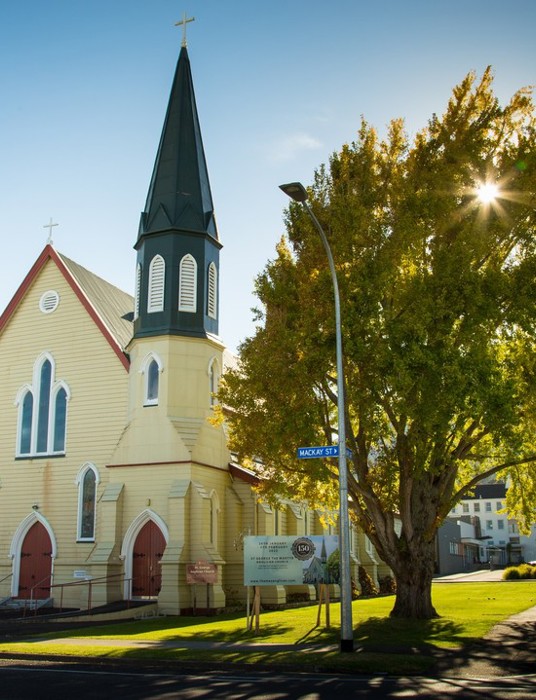
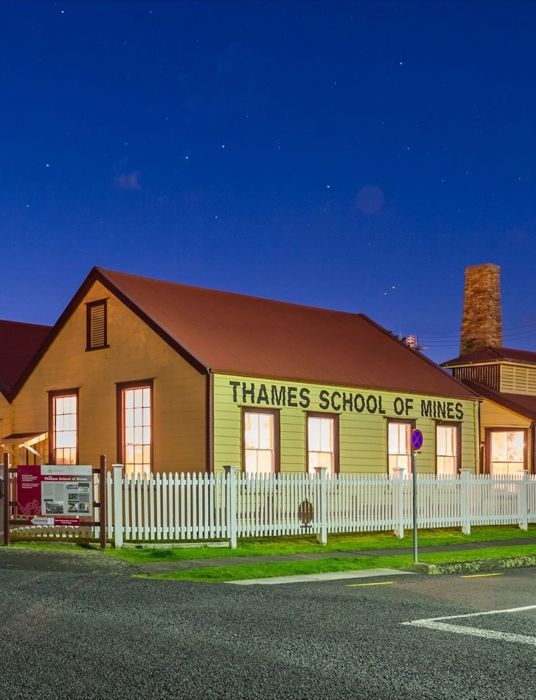
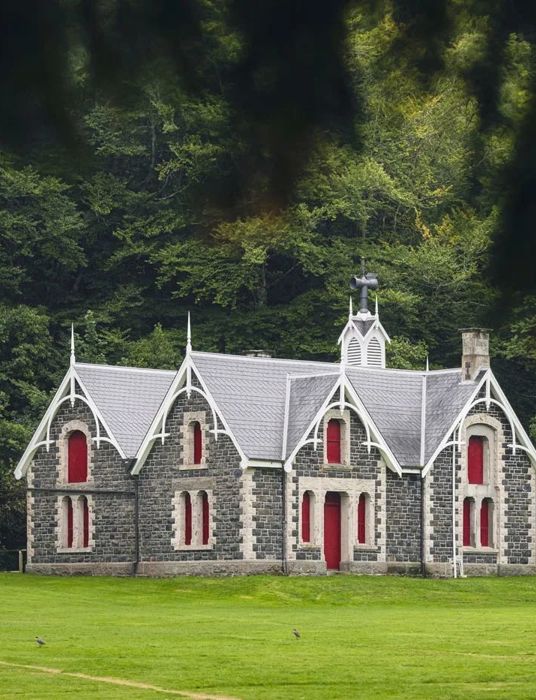
The Arts Centre in Christchurch is a collection of fine Gothic Revival buildings, formerly used by the Canterbury University College (now the University of Canterbury) and two of the city's secondary schools. Construction on the buildings for the Canterbury University College, which later became the University of Canterbury, began with the building of the Clock Tower block. This building, which opened in 1877 and was designed by Benjamin Woolfield Mountfort, was the first building in New Zealand to be designed specifically for a university. The Girls' High School building opened in the following year, designed by Thomas Cane, and two years later the Boys' High School on Worcester St was built. Other buildings followed as the University expanded. Both schools moved off the site, in 1881 and 1926 respectively, and their buildings were taken over by the university. North and south quadrangles were established with the building of the library in 1914-16. As part of Samuel Hurst Seager's scheme to link the disparate buildings of the University, cloisters and arcades were built to link the various buildings, with the library dividing the two quads. The last stone building to be built was the Engineering Block, now the Court Theatre, in 1923.
By the 1950s it was obvious that the town site was too small for the university and plans were made to move the University out to the suburb of Ilam. The Fine Arts department was the first to move in 1957 with Engineering following from 1959. By 1975 the entire University had migrated and the fate of the town buildings was under debate. Eventually the entire block of buildings were transferred to the Arts Centre of Christchurch Trust Board and are now used for a variety of arts-related activities.
Overall the style of the buildings is essentially High Victorian Collegiate Gothic and was based on old English college traditions. The buildings are significant in that they represent aspects of New Zealand's educational history, both tertiary and secondary. They illustrate the intention of the Canterbury settlers to create a colonial equivalent to Oxford and Cambridge. The buildings are also linked to significant developments in the arts and sciences. Ernest Rutherford, for example, was a student at Canterbury College and is now remembered by 'Rutherford's Den' in the Arts Centre. Many well-known New Zealand artists also trained at Canterbury including Evelyn Page, Rita Angus and William Sutton. Apirana Turupa Ngata, Ngati Porou leader and Member of Parliament, studied for his Bachelor of Arts at Canterbury from 1890 - 1893 and was the first Maori to complete a degree at a New Zealand university.
The Arts Centre complex was registered by the New Zealand Historic Places Trust/Pouhere Taonga, as a group in 1990 in order to recognise the historical and architectural importance of not just the individual buildings but the importance of the complex as a whole. It is significant as the site of one of the earliest of New Zealand's university colleges and as a splendid collection of Gothic Revival buildings designed by a variety of Canterbury architects. It now has an important role in Christchurch as a focal point for the city's art and crafts community.
Historical Significance
The clock Tower block was New Zealand's first permanent building designed specifically for university purposes. The first plans were drawn up in 1873 but financial restraints meant that they had to be much modified and building delayed. The intention was that the buildings would be a colonial equivalent of the "Christian" (i.e. Gothic) buildings of England, particularly the colleges of Oxford and Cambridge from where most of Canterbury's "founding fathers" had come (Gardner, 1972, pp.17-18). This illustrates well how the Canterbury Colonists continually looked back to "Home" (England) for inspiration.
The buildings illustrate educational aspects of New Zealand's history - not only of Canterbury College established as a college of the University of New Zealand in 1873 (High & 1927, p8) but also of the Girls' and Boys' High Schools in Christchurch, the first homes of those schools being now part of the Arts Centre complex.
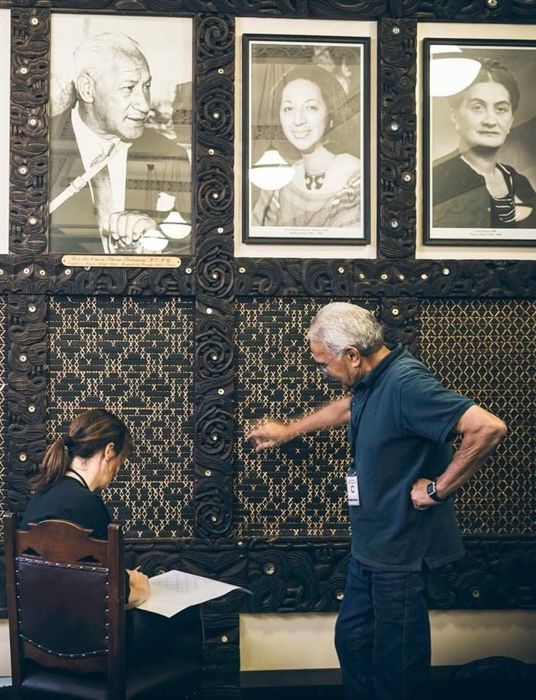
Many major developments in the arts and sciences have also taken place within the buildings. Ernest Rutherford, for example, an illustrious student of Canterbury College remembered by a permanent display in "Rutherford's Den" at the Arts Centre.
In 1975 the Canterbury College buildings were taken over by the Arts Centre of Christchurch - the site remains a hive of activity, and the buildings a focal point for the arts and community service activity.
Physical Significance
ARCHITECTURAL SIGNIFICANCE:
Given that they were built in a piecemeal fashion over many years, the final result of the buildings programme shows remarkable consistency. Until the second decade of the twentieth century the buildings on the site had made up a rather inharmonious medley of styles and materials.
The buildings designed specifically for the College are particularly significant in that one thinks of them as Gothic even though there is scarcely a pointed arch, the quintessential feature of medieval Gothic, to be found anywhere. The buildings are a kind of a historical Gothic. In selecting Gothic as the architectural style for Canterbury College, the ideals of the Canterbury Association Colonists were being maintained. Its models, Oxford and Cambridge, had played an important part in the Gothic Revival movement from the second quarter of the nineteenth century. Gothic was seen as reflecting historical, national (English), Christian, and social beliefs. As far as was possible within financial constraints the early College buildings were designed in accordance with Ecclesiological principles. By the twentieth century, however, architectural theory had changed somewhat and some of the later buildings do not adhere strictly to such principles.
The Great Hall is probably the best interpretation by B.W. Mountfort of Collegiate Gothic architecture, and as a group, the buildings are a particularly fine example of High Victorian architecture.
TOWNSCAPE/LANDMARK SIGNIFICANCE:
The precinctial character of this complex of consistent buildings is outstanding. The entire block with Canterbury Museum and Christ's College form a conservation area with a series of superb streetscapes.
Construction Professionals
Notable Features
Clock Tower Block, Great Hall, Hight Block, Old Art School, Old Chemistry Block, Collins Block, Centre Gallery, Scott Block, Engineering Block, Old Physics Block, Old Botany Block, Observatory Block, Academy Theatre, Old Boys High School, the Cloisters.
The ceiling of the large room on the lower level to the right from the main entrance of the clock tower block is made of a series of concrete arches supported by wrought springers - it was especially designed in this way for the prevention of overhead sound.
The Great Hall, with its dominant window on the north elevation and conical roofed staircase turret at the south-west end is also very striking on the interior. The "ridge and furrow' barrel-vaulted ceiling, for example, is made of carved alternating bands of rimu and kahikatea - a "mature" kind of constructional polychromy.
The Biological Laboratory building is interesting for its observatory tower with machicolations and revolving dome roof; for the spiral staircase rising beneath a pair of arches and the false tourrelle in the south-east corner facing the south quadrangle; and for the ornamental loop-hole in the form of a Latin cross on the east elevation chimney.
A notable feature of the large Engineering extension (1921-3) is the long Oamaru stone panel carved in a row of shields separating the upper and lower windows on the north and south elevations - this was a common feature of Tudor Gothic buildings. The buildings north-east corner joins at the old Boys' High School with a false crenellated tower.
Construction Dates
- Original Construction: 1876 (circa) - 1877 (circa)
- Modification: 1878 (circa) - 1879 (circa)
- Modification: 1890 (circa) - 1891 (circa)
- Original Construction: 1876 (circa) - 1878 (circa)
- Modification: 1893
- Modification: 1901 (circa) - 1902 (circa)
- Original Construction: 1878 (circa) - 1879 (circa)
- Modification: 1895 (circa) - 1896 (circa)
- Modification: 1912 (circa) - 1913 (circa)
- Modification: 1908 (circa)
- Original Construction: 1881 (circa) - 1882 (circa)
- Modification: 1887 (circa) - 1888 (circa)
- Modification: 1915 (circa) - 1917 (circa)
- Original Construction: 1895 (circa) - 1896 (circa)
- Modification: 1917 (circa) - 1918 (circa)
- Original Construction: 1901 (circa) - 1902 (circa)
- Original Construction: 1905 (circa) - 1910 (circa)
- Modification: 1913 (circa) - 1914 (circa)
- Modification: 1921 (circa) - 1923 (circa)
- Original Construction: 1908 (circa) - 1910 (circa)
- Original Construction: 1914 (circa) - 1915 (circa)
- Original Construction: 1915 (circa) - 1917 (circa)
- Modification: 1915 (circa) - 1917 (circa)
- Modification: 1938 (circa)
- Modification: 1986 (circa)
- Other: 2010 (circa)
Construction Details
Most of the buildings are constructed of stone-faced brick. The stone used is mostly Port Hills Basalt or Halswell Basalt, and the facings Oamaru Stone. The limestone facings on the Clock Tower Block (1876-7) were originally from Coal Creek, Pleasant Point but their rapid deterioration necessitated their replacement with Oamaru stone in the 1890s. The entrance columns of Armson's Boys' High School building are made of porphyry and the Chemical Laboratory has Timaru basalt steps with Hoon Hay basalt entrance columns. The east wall of the old Electrical Laboratory, and south and west walls of the old Hydraulics laboratory remain unfaced plain red brick. The roofs are slate.
Other Information
This historic place was registered under the Historic Places Act 1980. This report includes the text from the original Building Classification Committee report considered by the NZHPT Board at the time of registration.
Report Written By
Melanie Lovell-Smith
Report Completed
20-Aug-2001
Information on
this page is correct to the best of the Trust's knowledge. If you have any additional
information you would like to share with the Trust, please
contact the Registrar.
You may wish to contact the Trust to view our paper records.