Skip to content.

Historic New Zealand - Pouhere Taonga

Embassy Theatre

print page

9-11 Kent Terrace and 2-4 Majoribanks Street, Mt Victoria, WELLINGTON

Tell us what you think about the Register Online.

We're looking for ways to improve the Register Online and people's experiences when using it. Please help us by completing this brief survey.

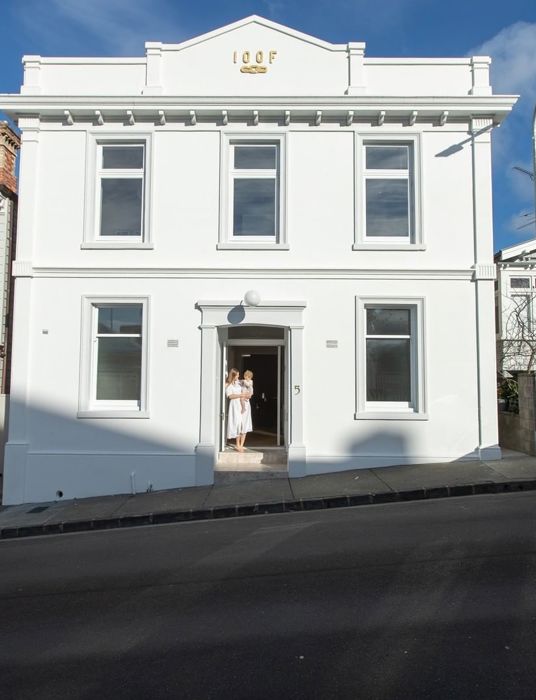
Embassy Theatre
Embassy Theatre. Photographed by Helen McCracken 1/08/2008. Copyright NZ Historic Places Trust

Enlarge image

De Luxe Cinema
De Luxe Cinema. Copyright Alexander Turnbull Library, Wellington

Enlarge image

Registration Type
Historic Place Category 1
 
Register Number
7500
 
Date Registered
7-Dec-2001
 
Legal Description
Lots 24-27 DP 240 (CTs WN51D/448, WN122/31), Wellington Land District
 
Extent of Registration
Extent includes the land described as Lots 24-27 DP 240, Wellington Land District and the building known as the Embassy Theatre and its fittings and fixtures (Refer to map in Appendix 1 of the Information Upgrade Report for further information).
 
City/District Council
Wellington City
 
Region
Wellington Region
 
Summary
The Embassy Theatre is one of the last major theatre buildings in the Wellington's central business district dating from the golden age of cinema. Opened in 1924, its size and location at the end of Courtenay Place have made it a landmark in the city for more than eighty years.

In December 1922 William Robert Kemball (1881-1969) acquired four properties along Kent Terrace. Kemball was the owner of Kemball Theatres, a successful New Zealand theatre company during the 1920s.

He hired the architect Llewellyn Williams to design the new theatre. Williams, who had been in partnership with notable Wellington architect Frederick de Jersey Clere since 1919, had recently formed his own practice. He was later to make a name for himself remodelling picture theatres in New Zealand as well as designing a number of prominent Wellington buildings, many of which remain today. A W. Williamson of Christchurch was the building contractor.

The new theatre was an impressive structure occupying a footprint that extended 27 metres along Kent Terrace and some 52 metres along Majoribanks Street. It was four stories high on its main frontage on Kent Terrace facing Courtenay Place, with an even higher portion behind accommodating the auditorium. The main façade featured restrained Classical motifs including acroterion, Greek key friezes, roundels and decorated columns. On the Kent Terrace side of the building was the main entrance, flanked by four shops. A further three were provided for along Majoribanks Street.

Inside was a large entrance foyer containing the ticket office and toilet facilities. Swing doors led to a vestibule that opened up into the stalls. The main entrance foyer was noted for its tiled walls; a feature that continued up the two marble lined staircases leading to the circle. The auditorium was 22 metres in width by 27.7 metres in length, with the dress circle extending three fifths of the length. At the front of the auditorium was a stage accommodating the screen and between the stage and the stalls was room for an orchestra. (Apparently the orchestra played for the first three years of the theatre's life and was then replaced by a Wurlitzer organ.) The Mayor of Wellington B. A. Wright opened the Theatre de Luxe on 31 October 1924 with great pomp and ceremony.

During the Depression Kemball ran into financial difficulties and in the late 1930s the De Luxe Theatre Company, under which the theatre was managed, was taken over by Robert Kerridge. Kerridge had begun his theatre business in the Gisborne in the 1920s. His interests grew quickly and he acquired theatres in the Bay of Plenty and, by the 1930s, in Auckland. He took over the Fuller-Hayward chain and, following a merger with the British theatre company Rank, formed Kerridge Odeon. By the time Kerridge acquired the De Luxe, which he renamed the Embassy, he was the owner of the biggest theatre chain in the country.


Internationally, in the late 1950s, the arrival of television was beginning to impact on theatre attendance. To combat this, cinema in the United States introduced wider screens as a new device to keep audience interest. Wellington's Embassy Theatre was the first cinema in New Zealand to make use of this innovation. In 1960, the same year that television began in New Zealand, a 70mm screen was installed and once again the theatre was reopened with numerous dignitaries in attendance including Prime Minister Sir Keith Holyoake.

During the early 1970s the theatre underwent significant alteration. The ticket offices were removed and rebuilt and a large part of the original decoration in the entrance foyer removed. The ramp to the circle and open wells to stalls were removed and a new floor was built between the stalls (which were eventually removed) and the circle. In the space created were placed a showroom and offices. The access to the coffee shop from the main entrance foyer was also closed.

In 1991 the building was acquired by Brierley Investments Limited. The intention was that it would be renovated to provide a home for the Royal New Zealand ballet. This did not eventuate. In 1995 the Embassy Theatre Trust was formed to save and restore the building. The Trust, with the help of the Wellington City Council, eventually purchased the property in 1997. Between 1998 and 2003 the Embassy was refurbished with parts of the building being sympathetically restored. The auditorium was somewhat modernised to cater for the demands of current cinema goers. As part of the earthquake strengthening of the building a concrete floor was laid between the circle and the stalls.

In December 2003 the Embassy received national and international attention for hosting the world premier of the final part of Peter Jackson's Lord of the Rings Trilogy. In 2004 the ownership of the Embassy was transferred to the Wellington City Council.

The Embassy Theatre is an important reminder of the development of cinema in New Zealand. The Embassy is associated with two important people in New Zealand cinema history William Kemball and Robert Kerridge. It was constructed during the heyday of the cinema, when going to the pictures was treated as much more of an event than it is today. The subsequent changes to the building reflect the changing attitudes of New Zealand society. Societal changes influenced by the arrival of television reduced patronage and led to the adoption of new devices to attract back cinema goers. The association with the Lord of the Rings Trilogy, New Zealand's most acclaimed cinematic achievement to date has added to the Embassy's significance. The theatre is held in high esteem by the community as shown by the efforts made to save the building in the 1990s and its recent refurbishment. Today the Embassy Theatre remains a prominent feature in Wellington's entertainment district of Courtenay Place and much-loved venue by the Capital's movie goers.


Construction Professionals
 
Construction Dates
  • Original Construction: 1924 (circa)
  • Modification: 1929 (circa)
  • Modification: 1945 (circa)
  • Modification: 1951 (circa)
  • Modification: 1951 (circa)
  • Modification: 1960 (circa)
  • Modification: 1970 (circa) - 1972 (circa)
  • Modification: 1970 (circa) - 1972 (circa)
  • Modification: 1970 (circa) - 1972 (circa)
  • Modification: 1998 (circa) - 2003 (circa)
  • Other: 2003 (circa) - 2010 (circa)
 
Information Sources
  • Conservation Plan,Ian Bowman, 'A Conservation Plan for the Embassy Theatre, Courtenay Place Wellington', Embassy Theatre Trust, 1997
  • Evening Post,31/10/1924, 22/12/1960
  • Wellington City Council,KENT2, Embassy Theatre, Wellington City Council Building Inventory 2001, Non Residential Buildings, Boffa Miskell Limited and Chris Cochran
  • New Zealand Building Progress,Vol XIX, no. 8, April 1924
 
Other Information
A fully referenced Upgrade report is available from the NZHPT Central Region Office
 
Report Written By
Helen McCracken
 
Report Completed
10-Sep-2008


Information on this page is correct to the best of the Trust's knowledge. If you have any additional information you would like to share with the Trust, please contact the Registrar. You may wish to contact the Trust to view our paper records.