Archaeological deposits exposed on the eroding face
Rachel Darmody, NZHPT
Background
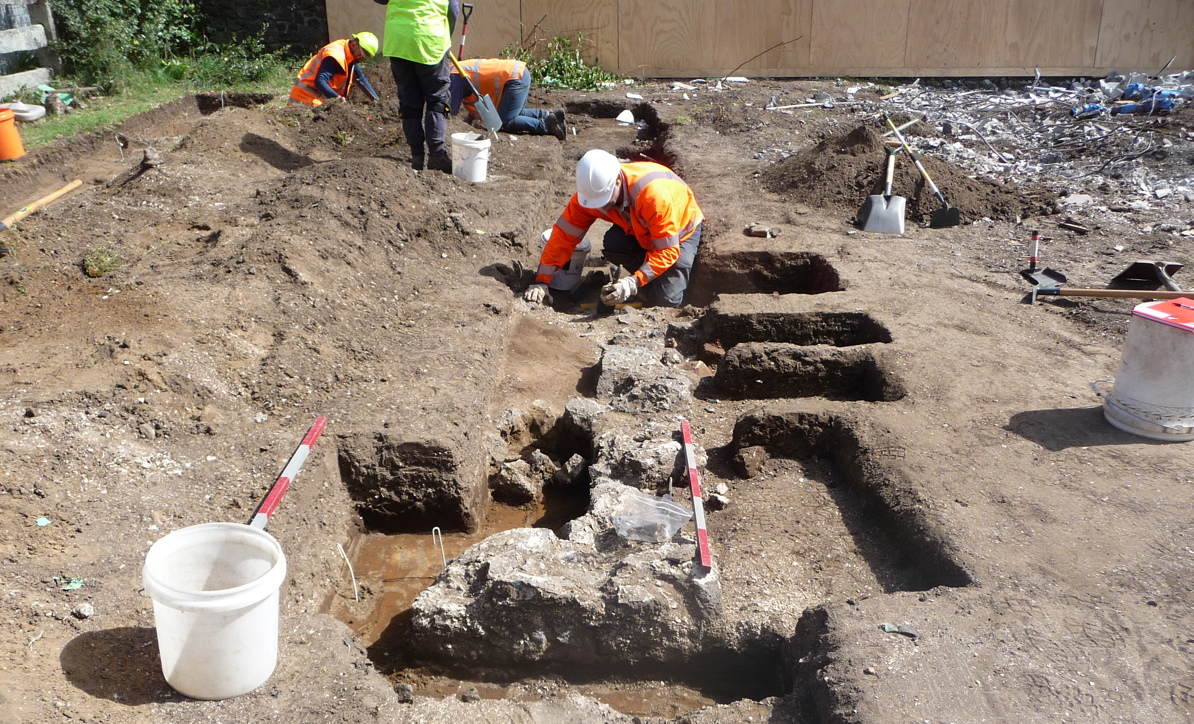
The archaeological excavation at Cook's Cove will salvage information from a site that is threatened by coastal erosion. The site is located on the southern bank of the river mouth at Cook's Cove.
It is an early site, probably dating to the 14th or early 15th century AD, based on the types of artefacts and midden material visible along the exposed edge. The age can also be assumed due to the presence of Loisels Pumice, and this site was one of Harold Wellman's type sites for his 1962 publication Holocene of the North Island of New Zealand.
Such sites are rare and because this site is currently being actively eroded by the sea a decision was made to carry out an excavation to retrieve valuable information prior to the total destruction of the site - an event that is not far off.
The landowner is Hauiti Incorporation, and the iwi is Te Aitanga a Hauiti. Both parties have consented to the excavations and authority to undertake the investigations has been granted by the NZHPT, in accordance with the requirements of the Historic Places Act 1993.
The work is being funded by the NZHPT, The University of Otago and the Gisborne Branch Committee of the NZHPT. It is being carried out in partnership with Te Aitanga a Hauiti.
Aims of the Research
Targeted excavations on the site aim to retrieve midden (prehistoric food remains), material culture and radiocarbon samples.
The midden will be used to reconstruct subsistence activities and some environmental information. The material culture will assist in defining site function and relationships with other early New Zealand sites. The radiocarbon samples will provide information on the exact age of the site. We will also attempt to expose large enough areas to identify features such as house floors and oven or cooking areas.
Questions?
For questions about the Cook's Cove excavation, contact archaeology@historic.org.nz