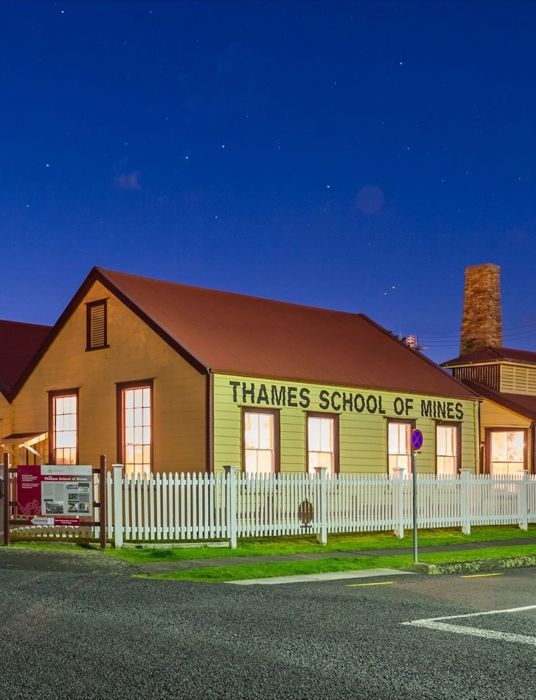
Collapsed chimney at the Lyttelton Timeball Station
Courtesy of Paul Titus, for NZHPT
The Christchurch-based office of the New Zealand Historic Places Trust has relocated following the February 22 earthquake, telephone +64 3 357 9629, fax +64 3 358 9628 email earthquake-related enquiries to quakeenquiries@historic.org.nz or information@historic.org.nz for other enquiries.
Our thoughts and best wishes are with everyone affected by this event.
The New Zealand Historic Places Trust (NZHPT) is working with Councils to provide advice about damage to historic buildings and structures and character homes.
Safety of people is of utmost importance. Priority should then be given to stabilisation, repair, and reconstruction.
Many buildings that appear to have sustained considerable damage may, in fact, be repaired. Building owners should seek appropriate professional advice. There should be no unnecessary clearing or removal of heritage buildings or structures.
Where can I get advice?
  |
The NZHPT, Councils and ICOMOS New Zealand have compiled and are regularly updating lists of heritage specialists who may be able to provide advice and to be engaged by property owners to carry out conservation repairs:
|
Due to the large number of enquiries, the NZHPT and Councils are not able to respond to all calls and emails immediately. All enquiries are being logged.
|
To record any issues or concerns relating to heritage properties, please email the NZHPT, the Christchurch City Council, the Selwyn District Council or call the Waimakiriri District Council on 03 311 8900 or toll free 03 327 6834.
Visit the website of the Christchurch City Council Building Recovery Office, or click on the following link for further information about Christchurch Heritage.
Visit the websites of Selwyn District Council or Waimakariri District Council for information about their earthquake recovery efforts.
What about consents and permissions?
Advice should be sought from your Council and the NZHPT regarding any necessary consents prior to commencing any work.
The Historic Places Act and the protection of archaeological sites
Do you own a pre-1900 building which has been damaged by this quake or its aftershocks? Under the Historic Places Act 1993 (HPA) New Zealand’s pre-1900 sites – including buildings – are considered to be archaeological sites. Section 10 of the Historic Places Act directs that an archaeological authority is required from the NZHPT if an archaeological site (recorded or unrecorded) may be modified, damaged or destroyed in the course of any activity.

(Word format) |
Under the Canterbury Earthquake Response and Recovery Act 2011 a simplified and streamlined process has been set up to quickly consider work that affects archaeological sites to be undertaken. This is done by an Order In Council which will enable the Canterbury Archaeological Officer of the NZHPT to issue Emergency Authorities within three (3) working days after having received an application, or with five (5) working days if the application relates to a site of interest to Maori.
The Emergency Authority will be able to be exercised the day after it is granted unless the affected site is one of interest to Maori. Find out more in this information sheet (pdf, 27kb)
|
Use this Emergency Archaeological Authority application form (Word, 450kb) to make your application. Information required by CCC for exemptions for building consent to undertake demolition can also be used for the Emergency Authority application.
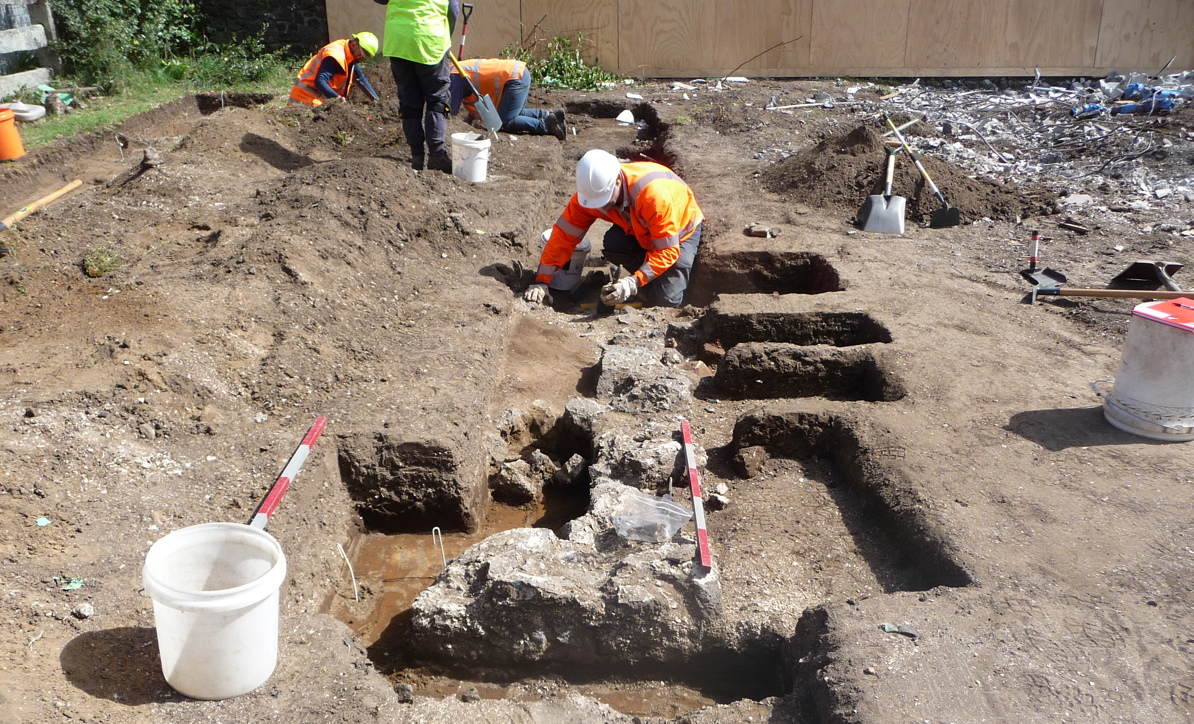
The purpose of the Emergency Authority is to be able to carry out demolition and partial demolition of pre-1900 buildings down to ground level for reasons of public safety and for work associated with the redevelopment of earthquake-affected sites. Some recording of the pre-1900 building and any subsurface archaeological material may be required.
All work carried out on sites or buildings that have been affected by the Canterbury earthquake that may affect archaeological sites within the Christchurch City Council, Selwyn District Council and Waimakiriri District Council boundaries is processed under the Canterbury Earthquake (Historic Places Act) Order 2011 - for example
- demolition and partial demolition of pre-1900 buildings,
- foundation removal, repair work or seismic strengthening of pre-1900 buldings affected by the earthquake,
- redevelopment of sites affected by the earthquake, or
- undertaking earthworks to repair infrastructure, such as roads, sewer and water lines.
You will be informed of the NZHPT's decision within three working days, or within five working days if the application relates to a site of interest to Maori. When sites of interest to Maori are affected, a stand-down period of 10 days applies before the authority may be exercised. In all other cases, the authority may be exercised the day after it is granted.
Visit www.archsite.org.nz to check whether there any recorded archaeological sites near the location of proposed works, or contact the Christchurch City Council Heritage Team or the NZHPT's archaeologists.
Contact:
Frank van der Heijden
Canterbury Archaeological Officer
NZ Historic Places Trust Southern Regional Office
tel: 027 688 9741
Email fvanderheijden@historic.org.nz
Note : The Christchurch-based office of the New Zealand Historic Places Trust has relocated following the February 22 earthquake, telephone +64 3 357 9629, fax +64 3 358 9628 email earthquake-related enquiries to quakeenquiries@historic.org.nz or information@historic.org.nz for other enquiries.
If my heritage building is considered to be unsafe, can I demolish it during a State of an Emergency?
During a State of Emergency, only the Civil Defence Emergency Management Group can authorise the demolition of buildings. The NZHPT and local authorities provide advice to Civil Defence to ensure that any unnecessary demolition is avoided.
If my heritage building is damaged, what is the process?
- Take photographs and document all actions, such as general tidying, cleaning, clearing debris, etc
- Make weathertight to avoid further damage and costs. Keep materials stored on site where possible.
- If there is damage, a claim should be lodged with the Earthquake Commission. See these useful FAQs (pdf) from the Waimakariri District Council's website for information about this. If it is a commercial building, lodge a claim with your insurance company because EQC does not cover commercial buildings.
- In making a claim to the EQC or your insurance company, you should state that the building is a heritage building and, if required, request an engineering assessment.
- The EQC or your insurance company will appoint a representative, normally Registered Valuer or Loss Adjuster to value the damage and obtain an estimate of repair costs. The EQC will also obtain a structural engineering assessment of your property if damage is severe.
- The NZHPT and the relevant Council should receive a copy of the structural engineering assessment and have the opportunity to discuss with the owner and EQC representative options for appropriate repair and/or reconstruction.
If you directly engage a structural engineer or other service (i.e. builder) please keep all records and documentation (especially receipts) for the purposes of any EQC/insurance claim.
Contact the NZHPT's Southern Regional Office for advice. Our Heritage Advisor Architecture will be able to assist with a range of enquiries relating to assessments, repair and/reconstruction of historic buildings.
Heritage Advice - Architecture
NZ Historic Places Trust
tel: (03) 363 1880
email: quakeenquiries@historic.org.nz
How can a heritage building be secured from further damage of aftershocks?
Structural integrity of buildings can be damaged by aftershocks, wind, ground conditions and vandalism. In the first instance, barriers must be installed to prevent the public from entering the building.
Shoring or propping should be installed by professional construction works. It should not be undertaken by individuals working alone.
Further information can be obtained from the following link to an article about scaffolding and temporary works for historic buildings.
What do I do with material that has been damaged, such as old bricks and timber?
Salvage work should be carried out by an experienced professional. There is always a risk of hazardous material and the risk of falling masonry, etc.
All necessary precautions should be taken to avoid damage to existing historic items that are to remain. Salvageable materials should be protected from the weather at all times (stored under a weathertight covering).
Removal of salvageable materials should be carried out by hand labour. Keep a complete record of the salvage process.
In the first instance, do not dispose of any material without careful sorting and assessment. Any important fabric such as bricks and timber should be cleaned, stacked and be available for repair/recycling. If you are uncertain about what should be disposed off, contact the NZHPT or a heritage specialist. See the information sheets below about repairing historic brickwork or stonework after an earthquake.
My chimney is damaged, what do I do?
A chimney can be rebuilt as a new structure that is compatible in style with the heritage values of the building. Chimney tops can be rebuilt in lightweight materials using carbon fibre.
While not ideal, replica chimneys can be built in plastered polystyrene or glass reinforced plaster. The replica should be designed to match the original chimney as close as possible on the basis of photographic and building plan specifications.
Advice should be sought from a heritage specialist on the repair, rebuilding and design of new chimneys.
If my heritage building is damaged to a point of being 'beyond repair', what is the process?
A structural engineering assessment is required for all buildings where the damage is severe. All structural engineering assessments that recommend demolition should be peer-reviewed and subject to a second professional opinion.
Resource consent from the council will be necessary to demolish a listed heritage building under the Resource Management Act 1991. Contact your local council for more information.
If your building was built prior to 1900, an archaeological authority from the NZHPT may be required also - see above for more information on this process.
My building is to be demolished, and detailed 'recording' is necessary, what does that mean?
Recording is a process of documenting a place. The aim is to make a record of the place before it is lost or changed.
The record may include photographs and drawings.The NZHPT advises that a heritage specialist should be engaged to record heritage places of high significance or complexity. For other photographic recording, the NZHPT can be contacted to provide advice.
The New South Wales Heritage Office provides guidance for photographic recording of heritage places (PDF 173kb) that can be adapted for New Zealand.
If you have a damaged and unsafe chimney:
- Photograph it
- Carefully make it safe – make secure or remove
- Make weather tight
- Keep the materials stored on site
Stained glass windows
The following advice is from Stewart Knowles, The Glassroom, Christchurch and member of the Glass Association of New Zealand.
Protect stained glass windows from any threats such as falling masonry. If the window is in immediate danger, place solid protection to both faces of the window. Do not use protective material which can flex inward and apply pressure to either face of the window. Do not secure the protective panels to either the beadings or the strengthening bards of the window.
The protective panels should be no closer than 50 mm from the face of the stained glass panels to allow air flow.If the window has been broken, do not attempt to remove these windows without specialist advice.
Panels that cannot be taken out without risking further damage to the panels should not be attempted until specialist advice or assistance is made available. Please note that normal deglazing methods for putty, steel frame work and mortar bedding are not acceptable and specialised equipment is required.
If the window has been destroyed, under no circumstances are broken stained glass windows to be swept up, bucketed and binned.
My damaged building houses a special collection of heritage artefacts, what should I do?
Special collections of heritage artefacts require special attention. Advice is available by contacting the Canterbury Disaster Salvage Team, by emailing co-ordinator@disalteam.co.nz.
For further information, visit the website of the New Zealand Association of Conservators of Cultural Materials.
In other media
Christchurch Earthquake Fact Sheet - prepared by IPENZ
March 2011
The Institution of Professional Engineers New Zealand (IPENZ) with the help of the Geotechnical Society and the Society of Earthquake Engineering, has prepared a fact sheet giving an overview of the February earthquake and performance of engineered systems, liquefaction and the building safety evaluation process.
Read the fact sheet (pdf, 1 mb)
Fact SheetCity Council Advisory - no pre-emptive demolition
9.09pm Wednesday 8 September 2010
Owners of heritage buildings are advised not to demolish heritage listed buildings without the express written authorisation of the Christchurch City Council. Demolition cannot be undertaken without the written approval of the Council. There should be no pre-emptive demolition undertaken by building owners in advance of full structural assessment from a professional engaged by the building's owner with advice from Christchurch City Council.
Find out more
Currently Consulting On
The NZHPT has been consulting on a draft guide for Earthquake Strengthening: Improving the Structural Performance of Heritage Buildings. This guide updates the earlier 2000 version by focusing on providing links to other guidance sources, updated legislative provisions and providing a guidance framework for the assessment of proposed earthquake strengthening work relating to heritage buildings. You may find some useful information and advice in the draft guide (pdf, 693kb) or its associated information sheet (pdf, 167 kb).
The NZHPT has also consulted on a draft guide for Heritage Provisions for Earthquake Prone Buildings Polices under the Building Act 2004. The guide is informed by experiences of the Gisborne (December 2007) and Canterbury earthquakes. All territorial authorities must review their dangerous, earthquake-prone and insanitary buildings policies by March 2011. This revised guide is designed to assist territorial authorities prepare second generation earthquake-prone buildings policies. It covers topics of general policy approach, identifying earthquake-prone buildings, taking action on earthquake-prone buildings, post-disaster response, heritage precincts and incentives. You may find some useful information and advice in the draft guide (pdf, 530kb) or its associated information sheet (pdf, 195 kb).
Submissions on these documents has closed and we are reviewing these submissions for possible incorporation into the guidance series.