Membership of the Historic Places Trust entitles you to a range of unique benefits including a free subscription to Heritage New Zealand magazine.
From issue: August 2001

Waiuku's Historic Treasures

by Anne Barker

A quiet rural town south of Auckland is celebrating 150 years of European history this year.

The scow Jane Gifford moored in the river at Waiuku with the town's historic village on the far bank. Photo: Anne Barker

Waiuku is rich in rural history. The Kentish Hotel, the focal point of this country town, has witnessed almost 150 years of progress; such events as the introduction of the motorcar and electricity, and the effects of two world wars.

Waiuku was marked out by the Government in 1851. Earlier, its importance as a portage route between the Manukau Harbour and the Waikato River via the Awaroa Stream was well known to Maori. Once traders and missionaries had introduced wheat, potatoes and fruit to the Waikato, abundant produce from Maori gardens was transported by canoe down the Waikato River, taken across the Awaroa portage and then via the Manukau Harbour to Onehunga and the Auckland markets.

A steam vessel and scow tied up at Waiuku in 1908. The Kentish Hotel is in the background. Photo: Auckland Public Library, neg. no.A2016

Edward Constable from Kent was one of the first Europeans to settle at Waiuku in 1850. Seeing the potential of the young town and its strategic portage, he built the Kentish as an inn. In 1854 Constable applied for and was granted a publican's licence and the Kentish became the Kentish Hotel able to sell alcoholic beverages. The construction of the hotelmarks the beginning of European setttlement and of Waiuku as a trading centre. Today it is one of the oldest licensed hotel buildings in New Zealand. This year, Waiuku is celebrating 150 years since the building of the Kentish Hotel began.

Edward Constable is frequently regarded as "the father of Waiuku". As well as operating the hotel, he was a farmer with large land holdings, a trader and an operator of several flax mills. His bullock waggons hauled produce from Pura Pura on the Waikato River to the estuary at Waiuku on the Manukau Harbour where the goods were loaded on board his cutter for the trip to Onehunga. A report in an 1853 issue of The New Zealander states that 337 canoes arrived at Onehunga from the Waikato during the year with the total value of produce being 3,297 pounds.

The Kentish Hotel in Waiuku today. Photo: Anne Barker

The verandahs of the Kentish Hotel provided a gathering point for menfolk after Saturday market days to discuss anything from the latest prices at the cattle fair to party politics. The increasing noise throughout the day meant that no self-respecting lady would venture as far as the "Kentish" end of town.

The Kentish Hotel has always provided the backdrop to Waiuku's history and has been the focal point of many civic and social events. This was largely due to the dominating personality of Edward Constable who built and owned the hotel until his death in 1893. Cricket matches and shooting competitions were common in the paddocks near the hotel. The Maori King Te Whero Whero visited in 1860, Sir George Grey in 1861 and Prime Ministers Richard John Seddon, Sir Joseph Ward and William Massey in later years.

The Jane Gifford, Waiuku's ninety-year-old sailing scow, at her mooring at the Tamakae Reserve in the town. Photo: Anne Barker

In keeping with Edward Constable's Kentish background, a hunt was first organised in the winter of 1898. Members of the Pakuranga Hunt Club travelled to Pukekohe by train and stayed at the Kentish Hotel. Horses and hounds were housed in the nearby stables and the next morning 400 eager local and visiting huntsmen followed the chase. Thereafter the hunt was an annual event and the ball that followed was a social occasion not to be missed.

In spite of numerous petitions for a canal to link the Waikato River and the Manukau Harbour, this was never built. With the construction of the Great South Road, Waiuku was no longer at the centre of a thriving trade and gradually became a rural backwater. Waiuku often referred to itself as "The Port of Franklin" as a steamer went three times a week to Onehunga and often as many as four scows were tied up at the nearby jetty. Today the ninety-year-old scow Jane Gifford is moored at the jetty at Tamakae Reserve across the road from the Kentish Hotel.

The twenty-metre Jane Gifford originally carried cargo on the East Coast. In 1985, the last owner of the vessel, Captain Bert Subritzky, donated the then derelict scow to the Waiuku Museum Society for restoration. "We wanted an icon for Waiuku that would reflect the old maritime heritage," says Clyde Hamilton, President of the Waiuku Museum. "The goal was to restore the Jane Gifford so she could take passengers for cruises on the Manukau Harbour." During the eight-year restoration programme, the committee of the Museum Society raised $1.1 million and volunteer labour virtually rebuilt the vessel, replacing all 2,500 hull bolts. Seventy per cent of the hull was sound; the rest showed signs of the ravages of toredo worm.

For five years the Jane Gifford offered popular sailing trips. Unfortunately last year it was discovered that the vessel needed major repairs to her hull to meet marine survey requirements. The Waiuku Museum Society has the task of raising a large sum of money to replace the decaying centre case and sub-deck area. The Society will then again be able to offer cruises out of Waiuku.*

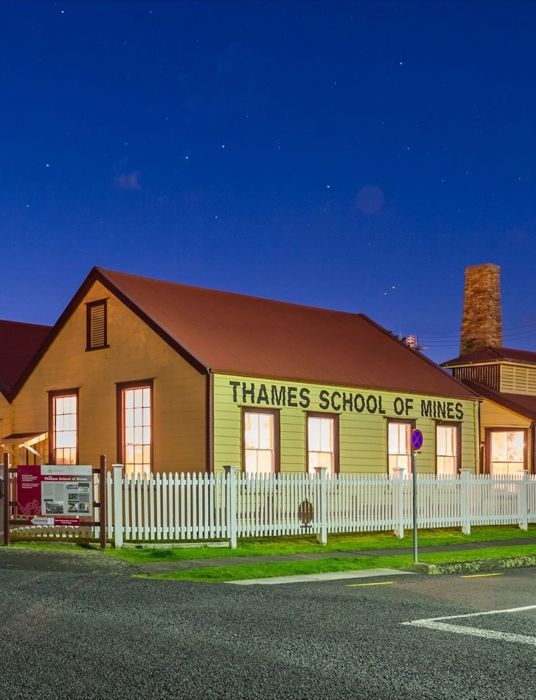
Near the Jane Gifford on the Tamakae Reserve is the Waiuku Museum which offers fascinating insights into local history. A collection of historic buildings at the Waiuku Museum includes the Hartmann House, a cottage built in 1886 by a German family and relocated by the Waiuku Museum Society in 1979. Today the pioneer cottage houses a successful craft co-operative. Pollock Cottage was built by James Drummond who emigrated from Scotland in 1906: it served as a family home and at one stage as the local telephone exchange. The Maioro Creamery was built in 1890 as a depot to which dairy farmers brought their milk. It needed considerable reconstruction when it was relocated, although the original style of shingle roof and the slatted windows were retained. Another building on the reserve is the Waiuku lock-up which was built in 1865 by the Waiuku Royal Cavalry Volunteer Corps and later taken over by the police.

Waiuku, just fifty minutes travelling time from Auckland and ninety from Hamilton, is an interesting destination for a day or week-end trip from these cities.

*Since this article was written the Jane Gifford has been moved to Warkworth where it is being retored.

Anne Barker is an Auckland writer.
 

Places to Visit

Learn more about the historic sites located in and around the Auckland region of New Zealand