New Zealand Historic Places Trust Pouhere Taonga


Membership of the Historic Places Trust entitles you to a range of unique benefits including a free subscription to Heritage New Zealand magazine.


From Heritage New Zealand, Autumn 2005

Takapuneke - the other Waitangi

by Matthew Leonard

A site of more than usual significance to our history is in danger of falling between the cracks of bureaucracy and ignorance.

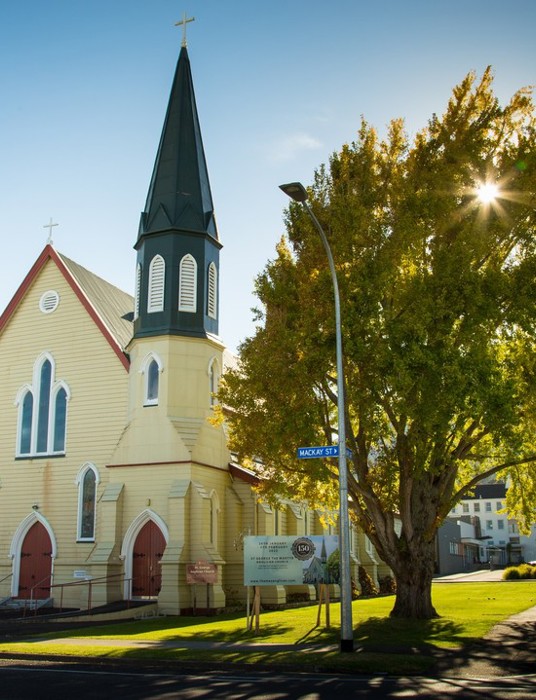
The view from Green's Point.
Photo: Matthew Leonard

Within walking distance of the most popular spots
of the Akaroa township is a site that very few visitors would be able to name. Some may climb the short path to the Britomart Memorial where, on August 11, 1840, Captain
Stanley raised a flag and gave “the first effective
demonstration of British sovereignty on the South Island”,effectively thwarting French imperial ambitions in New Zealand.Yet, from the fenceline of the memorial on Green’s
Point, visitors can look across the slopes of Takapuneke/Red
House Bay, a place that, it can be argued, constitutes the
missing link in the story of the Treaty of Waitangi.

The Ngai Tahu hapu Ngai Tarewa and Ngati Irakehu are
the turangawaewae of Takapuneke and Akaroa Harbour.
Whalers were trading on Horomaka (the Maori name for the peninsula) in the early 1800s, and by 1830 Takapuneke was the site of a bustling cosmopolitan trading pa, an important centre for trade in flax/harakeke, much in demand by British shipping. It was under the care of the upoko ariki (paramount chief) of northern Ngai Tahu, Tama-i-hara-nui (spelled Te Maiharanui in most versions), who had his primary base in a well-defended pa at Kaiapoi.

Takapuneke.
Photo: Matthew Leonard

Most accounts refer to the death of a number of Ngati Toa chiefs during a trading dispute at Kaiapoi in 1828 as the primary source of the enmity between the Ngati Toa chief
Te Rauparaha and Tama-i-hara-nui.Whatever the interpretation of the background events, the story continues with the appearance of the British mercantile brig Elizabeth in the bay off Takapuneke pa in late November 1830.

On board the Elizabeth with Captain John Stewart were Te Rauparaha and about 100 Ngati Toa warriors; essentially on
a revenge mission but also with aspirations for controlling the
lucrative trade in pounamu.

The Britomart Memorial, where Captain Stanley "gave the first efective demonstration of British sovereignty on the South Island.
Photo: Alexander Turnball Library F-10420-1/1 (6316)*

Promised payment in the form of 50 tonnes of flax, Stewart had sailed south from Te Rauparaha’s stronghold on Kapiti Island, effectively under charter. While Te Rauparaha and his warriors concealed themselves, Stewart managed to lure Tama-i-hara-nui and his wife and daughter on board with a promised trade in firearms.Te Rauparaha then sacked Takapuneke and killed many of its inhabitants, estimated to be up to 200 people.Tama-i-hara-nui himself was later put to death near Otaki by the widows of the Ngati Toa chiefs killed at Kaiapoi. While the bloodshed at Takapuneke affected people throughout Ngai Tahu, the events at Takapuneke have remained a particular sorrow to the people of Horomaka.

John Stewart’s complicity in the so-called Elizabeth Incident
was one of a series of events that ultimately led to the Treaty of Waitangi.The Elizabeth subsequently berthed in New South Wales, where news of the massacre had spread. Governor Darling brought charges against Stewart for his involvement in the bloodshed, and representation was also made by two Maori emissaries from Akaroa for stronger protection of Maori by the British Crown against the excesses of its subjects.

For parochial political reasons, Stewart was able to escape
prosecution, but a petition from 13 northern chiefs made to King William IV led the Crown to promise greater protections.
This led the British government to appoint an official resident to New Zealand, effectively a powerless junior consul.The post went, of course, to that co-architect of the Treaty of Waitangi, James Busby, who took up residency in the Bay of Islands in 1833.

Two years later, Busby had 42 northern chiefs of the Confederated Tribes signed up to the Declaration of Independence, the document used to call up chiefs to sign the
Treaty of Waitangi in 1840.

The significance of the sites at Akaroa is further enhanced by
the signing at Onuku of the Treaty by Iwikau and John Love Tikao on 30 May 1840, the first South Island chiefs to do so.

Jumping forward to 28 November 1998, Onuku Marae was the site for the delivery by then Prime Minister Jenny Shipley of the official apology on behalf of the Crown to Ngai Tahu, the final stage in the settlement of Te Kereme (the Ngi Tahu Claim).

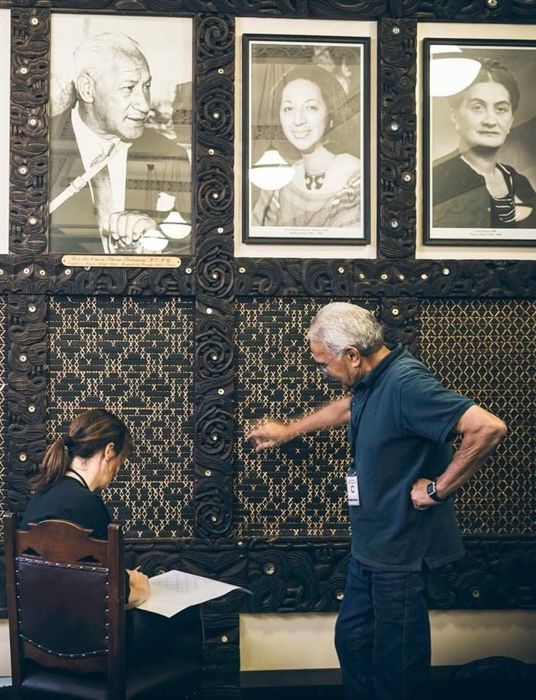
Onuku runanga chairman, George Tikao
Photo: Matthew Leonard

Much of the European scholarship on the Elizabeth Incident at Takapuneke and its connection to the Treaty story was recorded by historians such as Lindsay Buick well before World War I. It has taken somewhat longer for the Maori companion history to emerge. It is not, says Onuku runanga chairman George Tikao, because tangata whenua sought to hide the painful history of the place but that it was not until fairly recently that anybody bothered to ask. It was only eight years ago that he first walked on Takapuneke.

“The reason I did not ever walk on it was purely because it was something that was passed on to us by our ancestors.The first thing they told us as children was not to walk on this land ... they saw it as an urupa, they saw it as a place where their own people’s blood was spilled.That wasn’t a place that you went and played on.”

The ability of iwi to maintain their connection to this site, despite their physical alienation from the land without, they argue, adequate compensation, testifies to the importance of the events of 1830 to tangata whenua.

Nevertheless, it’s puzzling that a site that represents so many of the shared experiences of the nation has fallen “between the cracks”. While not technically absent from recent accounts of the history of the Treaty, it is accurate to say that its profile is not of the same order as the two sites with which it is often compared: the Treaty grounds at Waitangi and the Cook landing sites at Turanganui/Poverty Bay.

Renewed awareness of the significance of this part of Akaroa
was boosted around 1993 with the release of Harry Evison’s
comprehensive (and virtually unchallenged) account of South
Island Maori, Te Wai Pounamu – A history of the southern Maori during the European Colonization of New Zealand. Indeed, Evison and other historians suggest that the sites in Akaroa provide an even richer set of narratives around the nation’s identity than Waitangi. It tells “the story of the evolving relationship between Maori and European, culminating in the signing of the Treaty”, says Janet Stephenson, a lecturer and thesis student at Otago University.
“I suggest that Onuku, Takapuneke, Greens Point and Onawe
[another significant pa site in the Akaroa basin] are linked parts of a nationally significant heritage landscape with many layers of cultural significance.” It’s not just the story of the Treaty that can be told here, she points out. In 1839, Takapuneke became the site of Canterbury’s and possibly the South Island’s first cattle station, for example.

One possible reason for the site’s relative obscurity lies in what Stephenson identifies as different cultural perceptions around heritage landscapes; an approach that considers historic events in the context of the sites where they actually occurred.

Using Akaroa as a case study, Stephenson is currently developing a model for the interpretation of meaning within heritage landscapes generally.As part of her study, she interviewed 20 residents of Akaroa about their perceptions of local sites including Takapuneke. Maori informants largely referred to what she describes as “embedded values”, the human narratives carried in landscapes with which they have long associations. Scenic values were never mentioned. Europeans on the other hand like to see shapes and buildings; features that the slopes of Takapuneke don’t really offer although Akaroa itself has them in abundance. Combine these differences in perception with the recent utilitarian purposes for which the site has been designated, and it becomes a little easier to see how Takapuneke doesn’t occupy a more prominent position in the official histories of New Zealand.

While the events that took place at Takapuneke in the 19th
century have made it a place rich with meaning for both Maori
and non-Maori, 20th-century events have helped obscure the
significance of this site. Back in 1965, on land it had already
acquired,Akaroa’s council built a sewage treatment works. In 1979, it placed a rubbish dump on other land it had acquired at
Takapuneke, two acts regarded by Maori as a “defilement” of the land and, in the words of Harry Evison, “the ultimate in modern cultural oppression”.

The next phase of recent history begins in 1992, when the
council divided up the land. In common with other sites around
New Zealand, the land had been purchased with funding from
endowment lands vested in local authorities such as the Akaroa Borough Council after the abolition of the country’s provincial government system in 1876. (Essentially, endowment lands constitute a realisable asset to benefit the community at a later date, but usually come with strict guidelines governing their disposal.)

These 9.41 hectares (including the old rubbish dump) became
the Takapuneke reserve, administered by a management committee that is chaired by the Onuku runanga and consists of members of the runanga, council and local community. The handing over of administrative responsibility to the Onuku runanga recognised the significance of the site to iwi, which the council followed up with a formal apology in 1998. The remaining 14.13 hectares of Takapuneke were kept in the control of the council, and up until relatively recently were marked for sale and possible development into a 47-home subdivision.

This compromise was never to the full satisfaction of the Onuku runanga and, in 2002, they applied for the site to be registered as a wahi tapu by the Maori Heritage Council of the Historic Places Trust. In the words of the Onuku runanga: “Takapuneke is one of the most significant wahi tapu, wahi taonga sites in the history of Ngai Tahu. This sacred site is in the takiwa (area) of the descendants of Onuku who are held with the responsibility of Kaitiaki (guardian) for the many ancestral deaths lost in the 1830 massacre.” It became the first registered wahi tapu area on the mainland South Island.

Prime Minister Helen Clark, who is Minister for Arts, Culture and Heritage, supports public ownership of this site. However, recent interactions between Onuku runanga and other interested parties indicate that the government, including Chris
Carter, the Minister for Conservation and the Department of Conservation, is backing away from actively pursuing acquisition of the site.The non-intervention amounts to a “wait and see” approach to a proposed amalgamation between the Banks Peninsula District Council (BPDC) and the Christchurch City Council. Banks Peninsula MP and cabinet minister Ruth Dyson, who has been closely involved in discussions around the potential restoration and interpretation of the site, confirms that the Crown is reluctant to purchase land that is already in public ownership, albeit in the hands of the BPDC on behalf of the ratepayers of the Peninsula.While the current Banks Peninsula Mayor, Bob Parker, is sympathetic to the aspirations of the Onuku runanga for Takapuneke, his council is struggling to deal with enormous economic pressures funded by only 7500 ratepayers.

So, without financial imput from the government, and hampered by guidelines of fiscal responsibility within the Local Government Act, Bob Parker believes that the proposed Banks Peninsula/Christchurch City amalgamation could provide the solution for Takapuneke. Firstly, he believes the financial base offered by successful amalgamation would make the potential $1.3 million to $3 million the Takapuneke site might realise for the BPDC irrelevant compared to the additional values the site could have for the community. Paul Dingwall, until recently a science manager at DoC, concurs that a sensitive development of the Takapuneke landscape has “the potential to bring added social and economic benefits to a region already renowned for the qualities of its natural environment”. Secondly, the Reserves Act of 1977 allows for the administration of reserves of National (Sect.13) or Historic (Sect.18) significance by local government; something that Parker argues the current BPDC is inadequately resourced to do.

However, discussions around the potential amalgamation are barely underway, let alone detailed discussion about Takapuneke, and there is by no means universal support for the amalgamation from within the CCC. Hagley/Ferrymead councillor David Cox observed: “Land with sea views residentially are commanding a premium. Banks Peninsula District Council has such land but it is not ‘on the market’, maybe it should show (Christchurch) city residents that they are prepared to do their bit, not sit back and leach off our ratepayers.”

Perhaps with this kind of opinion in mind, Bob Parker has indicated that he would like to see some sort of pre-amalgamation agreement put in place, which might also show
support from a broader representation of Ngai Tahu.

Harry Evison believes that Ngai Tahu would be supportive but
offers a purist perspective. According to Evison, acknowledging the site has become an issue of national identity and shouldn’t be left to the vagaries of a local government amalgamation.“Let’s lift it off the shoulders of the people of Akaroa,” he says, arguing that the significance of the site warrants the direct attention of the Prime Minister’s office and rigorous advocacy by the Historic Places Trust,
the only agency he believes has the prestige to advance the cause. “It’s a heritage issue, not a conservation issue.”

Ultimately, a site like Takapuneke, strong on historical value,
perceived to be low on conservation values and with complex land title, sits uneasily within the remits of the agencies now deciding its future. Chad Huddleston is an American PhD student at Canterbury University who analysed Takapuneke as a case study of Maori-Pakeha relations. He has also analysed how the policies of the main agencies currently negotiating over Takapuneke are put into practice.

“Organisations, except HPT, see landscape – any landscape – only in terms of resource management.All policy is based on that. There are places for cultural management, but they are either really speaking to resource management or so ill-defined as to be useless”.

He goes on to say that he believes “many of the policy statements speak to kaitiaki as they have been told they must. But this is where the difference between policy and practice comes in. As long as it is left to the local councils to enact higher level government policy, (those policies) will more than likely not work.”

There are locations, however, where tangata whenua are able
to exercise their role as kaitiaki in joint management of significant heritage sites, albeit not with local government.

At Otatara pa in eastern Hawkes Bay, for example, representatives from Waiohiki marae have co-managed this
significant site in partnership with DoC for eight years. Assuming the status of the outstanding land at Takapuneke can be resolved, chairman of the Onuku runanga George Tikao envisages a joint management committee for the site comprising no more than eight representatives. He affirms the need for the Historic Places Trust to play a significant role in that group.

There is a possibility for the restoration of ngahere or native
bush on the site, although many of the details of how the runanga will deal with the sensitive issues of tapu and public access are yet to be fully explored.

On the matter of interpretation, the Akaroa Civic Trust, which, along with Onuku, has been advocating for the site for seven years, comments:
“We first need to secure the land and then enter into a long
discussion of its appropriate interpretation of both the Maori and European history of the site. In the future, it is hoped that this mutually agreed upon interpretation will be accessible in
proximity to the Britomart Memorial.The Civic Trust feels that
visitors don’t need to access the Takapuneke reserve since the entire area is easily viewed from the monument.”

Paul Dingwall, of the Akaroa Civic Trust, points to the
Ruapekapeka pa in Northland as a model for the kind of
interpretation the heritage landscape of Takapuneke could carry. Like Takapuneke, that landscape holds stories from both sides of the conflict that need to be integrated into our understandings of New Zealand history.On the day this writer visited the Britomart memorial, it was easy to see how a centre for interpretation and signage could provide additional meaning to what tourist marketing of the region continues to call French Akaroa.

“Very few landscapes in this country convey as much compounded heritage value as Takapuneke,” concludes Janet
Stephenson. “It offers huge potential for interpretation and
celebration of our bicultural identity.” By May, discussions at the local government level will have determined whether this
potential is to be realised.

 
* Photo: Permission of the Alexander Turnbull Library, National Library of New Zealand / Te Puna Matauranga o Aotearoa, must be obtained before any re-use of this image
 

Places to Visit

Learn more about the historic sites located in and around Canterbury region of New Zealand


Contact Us | Helpful Tips

© New Zealand Historic Places Trust Pouhere Taonga
Support the Trust by calling
+64 4 472-4341